Sharing Early Literacy Learning Journeys

Children write about items of interest – holidays or not

Written by Dr Coral Swan and published in Practically Primary in February 2010

After attending the ALEA conference in Hobart in July 2009 and hearing the words ‘Please don’t ask me to write or draw about what I did in the holidays’, I decided to look closely at what the children did write about on the first day back at school in third term.

My Year One students write about anything of interest in their journals on Monday, Tuesday and Wednesday mornings as an essential part of our literacy block (see schedule below).

Our morning

1. Roll
2. Calendar
3. Shared reading: big books/charts
4. Shared writing: class news
5. Co-operative show and tell
6. Journals
7. Home-reading books
8. Sharing time
9. Lunch
10. Outside play

Table 1: Morning schedule on board

The pre-writing talking time of co-operative show and tell (Swan, 2009) is central to journal writing because it enables the children to talk in small groups about topics of interest before moving to writing. It’s as if: ‘I have something to talk about – I have something to write about’.

Sometimes the children visualise what they will draw and write. This helps them focus on personal or class interests and the immediate task of writing and/or drawing.

In journals, children demonstrate what they can do with writing: construct sentences, form letters, spell words, leave spaces, label pictures, use capital letters, add punctuation and connect text and images. Children also read as they write, and after completing their writing, they read it aloud to me and/or peers.

Some children use classroom resources to help them write: Velcro words from word walls, sentence starters from fish-netting and word cards from labelled boxes. Children may also copy words from lists, charts and books. A spirit of help and co-operation pervades the room as children respond to classmates’ requests about letters, words and writing.

What did the children write about on day one, term three?

• events in their holidays
• objects they brought to school (just as they do any school day)
• friend’s objects
• going to the local agricultural show after school, that day
• an upcoming birthday
• family events from the previous day
• words from class word walls

What does the children’s writing show?

Children write about meaningful experiences and objects:

• 2 mentioned an event as ‘over the holidays’ (visiting town X with cousins)
• 3 mentioned an event without reference to ‘the holidays’
• 9 wrote about objects of interest brought from home
• 3 wrote about objects brought by friends
• 3 wrote about future events of interest to them as individuals – 2 to the local show and 1 an upcoming birthday
• 2 wrote about meaningful events on the previous day (parent’s work and cousin’s place) without reference to ‘the holidays’
• 1 copied words from the word wall (family and walked) but indicated this was not a family event

Samples of children’s journal writing:

An event mentioning the holidays
On the holidays my cousins came up to see us. We went to the reef with them. We stayed in a hotel with them. They left on Tuesday.”

“I went on the big boat that came into town.”

An event – but not mentioning holidays
I went swimming at the caravan park at Nana and Granddad’s.”

Personal objects of interest
Yesterday I got NRL cards. I have mascots. They have legs. They look cool except the Eels. The Kangaroos are AFL. The Titans look like they have armour. It looks cool.”

“I like my tiger. It is cute and very soft. It has a pink bow. It has lots of stripes. The stripes are black. It has purple and black eyes. I like my flower. It is cute with a smiley face.”

A future event of personal interest
I am going to the YYY show at 2 o’clock today. My Nana maybe will get me a show bag. “I will go on the rides maybe,” said X. I will have fun today. I like the big slide.”

What does the children’s writing tell me?

Children write about:

• what they are interested in, and
• what is meaningful to them

Significantly, that tenet doesn’t change whether it’s after holidays or not.

Why do I include journal writing in our literacy mornings?

Journals work in my classroom because children demonstrate what they know about language as they write/draw about interests and meaningful experiences (Swan, 2009). Subsequent child-teacher conversations develop and extend children’s learning through sharing, revising and explicit teaching.

Journal writing on paper or computers enables children to:

• choose what to write about
• decide how to write about it
• demonstrate understanding of written language
• develop independence as they write for various purposes
• learn more about using language (by calling on knowledge and experiences to integrate new understandings)
• gain confidence as they write (and read) about interests
• enjoy writing/drawing
• share their writing/drawing with others

What is my role in supporting, developing and extending this writing?

Writing practices and explicit teaching

In everyday classroom life we interact and use meaningful spoken, written and visual language in:

• modelled writing
• shared writing or joint construction
• independent writing
• free writing
• sharing time and
• celebrating writing accomplishments

Oceans of print

Children use meaningful print and images in the classroom to assist their writing and reading. The room contains:

• functional print
• word walls, lists, charts and banks
• word families
• sentence starters
• alphabet and word placemats
• labels, directions and instructions
• questions and reflections
• class books
• children’s books and topic books
• a range of boards, papers and pens for writing

Teacher-child conversations

During writing time, teacher-child conversations encourage, support and scaffold children’s attempts at writing. The conversations develop and extend learning because the conversation is immediately relevant to that child.

Written responses

In hearing children read their writing I often respond with a written comment, query or question to:

• participate as an interested reader
• demonstrate handwriting
• model correct spelling
• encourage more writing
• revise written conventions
• extend specific learning

Group sharing time

In sharing time I use children’s writing to model or explain language features and written conventions, e.g. a possessive apostrophe. Sharing time also enables us to provide constructive feedback to the writer by:

• acknowledging effort
• encouraging clarification
• seeking reasons for writing decisions
• making links between writing/ drawing
• celebrating accomplishments

Conclusion

Using children’s lives and experiences as vehicles for their early literacy learning fits with my deeply held belief that children learn best from their interests and  experiences—which are at the core of their talking, writing (and reading). Co-operative show and tell, prior to writing, affords children opportunities to talk in small groups about personal and class interests and experiences. Writing follows – and rarely do I hear, “I don’t know what to write” because children actively participate in the talking-sharing time and then, choose what to draw and write about.

Assigning a topic like ‘What I did in the holidays’ is not necessary when children are familiar with making choices in their writing. Children may well write about something they did in the holidays – but it does not have to be prefaced with ‘In the holidays….’ Children write about meaningful experiences and items of interest – holidays or not.

References

Swan, C. (2009). Teaching Strategies for Literacy in the Early Years. Norwood, SA. Australian Literacy Educators’ Association Ltd.

Copyright © C. Swan 2010 PP article: Children write about items of interest – holidays or not. (with some revsions and no photos)

The morning sun struggles through grey clouds and a gentle breeze greets me as I walk to the beach. The sand is cold beneath my feet. Small waves tumble forth leaving frothy white lace at the water’s edge. A dozen thoughts race through my head. It’s back to school tomorrow for the start of second semester. What’s in store for the first week?

Monday – Early Years’ professional development
The first day of a new term is traditionally pupil free with professional development (PD) for teachers. Today I present a session, in keeping with the brief, ‘focus on literacy in the early years’, with practical ideas for the classroom and links to the curriculum’. More on my session later…

Tuesday – children return
Talking, talking, talking. That’s Tuesday. The children always have so much to say after two weeks away from school, classmates and friends. Everyone gets to share – and to draw and write. Journal writing is especially exciting because as always, the children are free to write on topics of interest – no need for the restrictive request:  What did you do in the holidays?

Read more in my related article, Children write about items of interest – holidays or not’,  published in Practically Primary in February 2010.

Wednesday – new ‘old’ books to share
I can’t wait to share some new books with the children on Wednesday. I am not a shopper but sometimes I browse – books stores and second hand stores are my favourites. On the holidays I found several ‘old’ books and snapped them up:
The cat on the mat and friends, by Brian Wildsmith

Cat on the Mat and Friends

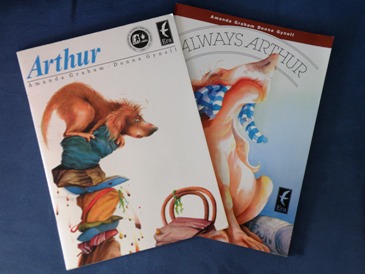
Arthur and Always Arthur, by Amanda Graham

Arthur and Always Arthur

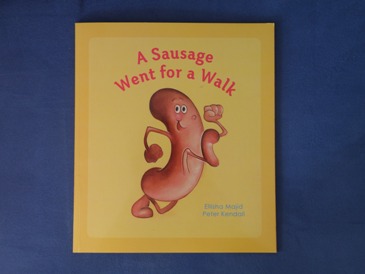
A Sausage Went for a Walk, by Ellisha Majid & Peter Kendall
I remembered this one because one year a boy came to school already reading and he read this book to the class on the second day of school – interestingly, I hadn’t seen it since.

A Sausage Went for a Walk

Say ‘Hello’ Wombat by Steve Parrish
This one is new. It has superb Parrish pictures of Australian animals with a repetitive and rhythmical storyline – so it will be interesting to see if the children take to it or not. Will it be taken as a ‘story’ book or as an appealing book to read? Stay tuned.

Say "Hello" Wombat

Friday – 100 day party
We have been counting and recording the number of days at school all year and it’s time to celebrate 100 days in Year One. Well, actually it will be day 99 for us – but we could not have a ‘party’ on a Monday!

Last year's 100 day count

P.S. Twitter
Over the past few days I had a taste of the Australian Literacy Educators’ Association (ALEA) conference in Melbourne via Twitter at @ALEA. Participants tweeted during sessions with notable comments from presenters, including Debbie Miller, Gay Su Pinnell, Susan Hill and Trevor Cairney. Yesterday I received Trevor Carney’s plenary address on his blog at   http://trevorcairney.blogspot.com/ and I was excited to read his statement ‘the words of literature are economical and powerful’ – with clear examples from books to demonstrate his point.

For people still on holidays, enjoy!
For children and teachers returning to school this week, enjoy!

Are you trying something new with your class this term?

A yellow cloth covers the collage table and tea, coffee and juice await parents and children. A blue cloth covered table awaits fruit platters, small pancakes and banana bread that will arrive with parents and children. Mozart wafts from the CD player in our mat area.

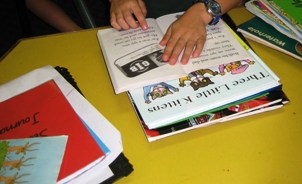
It’s 8am on the morning of our Sharing Breakfast – a regular event in the last week of term. Children share their work with parents and parents celebrate children’s accomplishments. Piles of books grace the hexagonal tables – children’s books they work in like journals, alphabet, maths, activity and news books.  Children choose three books to read to parents – and two books for parents to read to them. 

On the previous day, the morning message is displayed at the classroom entrance as a reminder to parents. Children’s colourful drawings add a personal touch.

The morning message is a reminder to all
Evidence of each child’s work and books to read with a parent are displayed on the hexagonal tables.
Henry reads ‘Zac Power’ to his mum
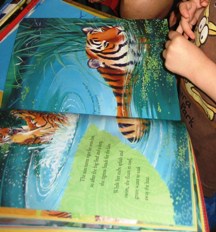
Jake looks at ‘Tigress’ (Dowson) whilst nearby, his big brother reads to their mum
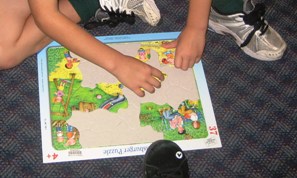
After all that sharing and eating, Ned chooses a Ravensburger puzzle

Parents stay for as long as it suits them. After sharing their child’s drawings, writing, reading books, numbers, science journals, etc., some parents head off to work – and they won’t even be late! Other parents stay and enjoy food, books, games and more time with the children.

How do you share children’s work with parents?

With thanks to Dr Suess for Great Day for Up, ours is a Great Day for ‘ch’.  
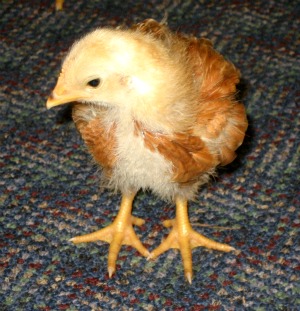
A child brings in four little chicks. They go cheep, cheep, cheep, cheep, cheep.
Children chatter about the chicks and cheer when the chicks run, jump and fly.

The children observe the chicks.  We take photos and make notes.
Children exclaim…
“Look at him jump.”
“Look out! She’s trying to fly.”
“They’re scratching and pecking the floor.”
“Now they’re cleaning their feathers.

Children talk, draw, write, read and share their work.

A lone brown chick on our mat area.

All 4 chicks on the mat area. They didn't want to go on the white paper in the foreground!

Before writing, children brain-stormed words about the chicks

Trevor's drawing of the brown chick to accompany his writing.

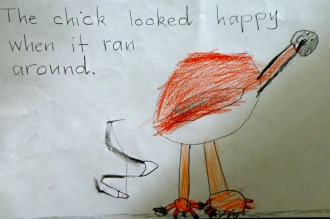
Carl's drawing and dictated sentence about the happy chick.

Mariah’s colourful drawing of 4 yellow chicks.
 
What pets have come into your classroom?
Tell us about an experience with a pet in your classroom.


Under 8s week was May 20-27. Our school celebrated our young children on Friday. The canopy and nearby grassy, treed area were dotted with ‘stations’ where children, younger siblings and parents participated in activities including:

  • playdough
  • blowing bubbles
  • making kites, crowns and masks
  • finger, face and easel painting
  • coloured chalk on blackboards and black paper
  • magnetic fishing
  • a giant parachute and
  • dancing


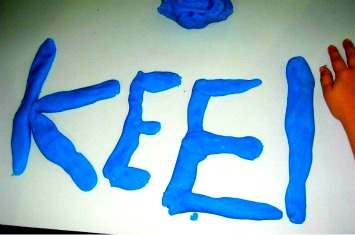
Through the eyes of a child: a playdough person.

I can write my name!

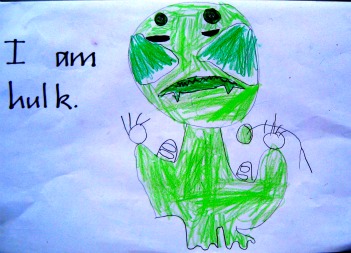
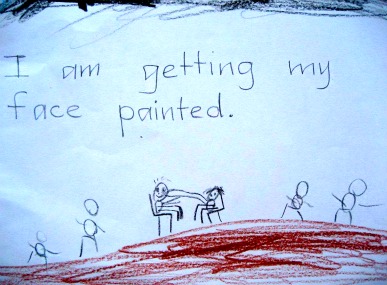
A child had his face painted as Hulk, then drew about it.

Face painting was popular.

The giant parachute was popular too!

 Looking for ideas to celebrate early years children in your school or your classroom? Click here.

What sorts of days for celebrating your children do you have in your state, province or territory?
In your school?
In your classroom?
 

The excitement began first thing Monday morning when Nyssa and her dad told us about an echidna they found when her dad was landscaping their backyard. Nyssa (aged 6) wrote about the echidna. Later we found pictures and information about echidnas. This is Nyssa’s story with her dad’s photographs…

An echidna in my backyard

I saw an echidna in my backyard on Saturday. I had a sleep over with my best friend Gretal and when we went outside, my dog found the echidna. It had spikes and the echidna was digging down.

Gretal, Meg and I played ponies together and then my dad gave us the picnic rug and we had alphagetti and cheese sticks. We had fun and after our picnic we went back to see the echidna. The echidna was gone. We liked the echidna. It had black and light brown spikes.

Then I was happy because I knew he was safe. I think he went to look for a new home to live in. I hope the echidna likes his new home. I liked the echidna and he liked me. I hope he doesn’t lose any spikes.

The echidna was digging down, down.
His spikes were black and dark brown.

Have you seen an echidna outside of a zoo?

 What do you know about echidnas?


Konnichiwa.
Japanese is the Language Other Than English (LOTE) taught in our school. To raise money for the Japan earthquake and tsunami victims, our LOTE teachers and Japanese parents organised ‘Japan Day’. The student body then participated in various cultural activities on offer. The activities included:

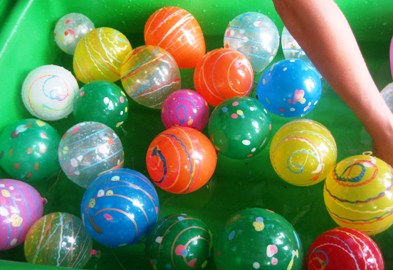
      • Mizu yoyo (water balloon yoyo with an elastic ‘string’)
      • Origami (paper folding)
      • Kimono dress up time
      • Jan Ken Pon (paper, scissors, rock)
      • Kendama (wooden toys)
      • Hachimaki (headbands)
      • Zumba

        Mizu yoyos waiting to be chosen by excited children

        Dressing up in kimonos was a favourite activity
Headbands were a favourite too. This one says ‘Pokemon’

Jan Ken Pon (paper, scissors, rock) was also a favourite – partly because if a child beat the mum opponent, the prize was a lolly!

Sushi and rice balls
 Sushi and rice balls are already on the Tuck Shop lunch menu – but LOTS were eaten on Japan Day.
 
A class book
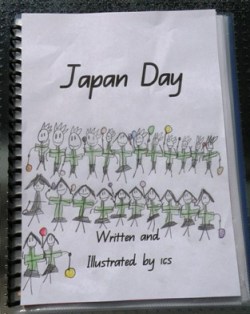
Next day, we brainstormed words about the experience and listed them on the whiteboard. Then, the children wrote about their day. In conversations about the writing, we talked of adding information, details and feelings.  The children drew colourful pictures on their printed pages of writing and added the pages to an A4 display book. Voila!  A class book for shared, independent and home reading.

Class book of children's writing and pictures about Japan Day

Class charts
Digital photos were used for class charts and displays with pictures, captions, labels and ‘stories’.

A visual PowerPoint
Photos and captions of the activities are on a lively and colourful Powerpoint presentation for classroom use.

Classic Language Experience
Japan Day was a classic Language Experience activity where we:

  • shared a hands-on class experience
  • shared spoken, written and visual language about the experience
  • brainstormed, wrote and used words about the experience
  • constructed class sentences about the experience
  • wrote and drew about the experience
  • made a class book from the children’s writing – for shared, individual and home reading
  • used photos, captions and sentences for reading charts and displays of the experience
  • used the children’s writing as high interest reading materials
  • re-lived the experience by interacting and re-reading the children’s work/products 

Sayounara…and please leave a comment

What did you like about Japan Day?

What new Japanese words did you learn?

We had a Book Fair at school all this week. I love Book Fairs – they give parents an opportunity to preview and buy books for their children. On Monday my Year Ones went to the library for a ‘book look’ at the wares available. The children wrote two items on their ‘wish list’ papers and later took them home – with the understanding that there were no guarantees parents would buy the items. After school, some parents and children went to the Book Fair to browse and buy. 

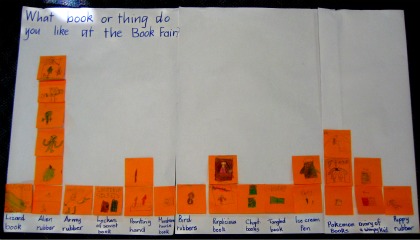
Next morning several children happily showed us their purchases. Others talked about possible/probable purchases.  Both interest and excitement were high so, going with the flow, I suggested we make a graph to find out what sorts of books and things the children liked at the Book Fair.  I hasten to add that the graph was meaningful, but not beautiful!

What book or thing did you like at the Book Fair?

Class Book Fair graph: What book or thing do you like at the Book Fair?

What did we find out?
13 children liked ‘things’
12 children liked books

The details were interesting…

  • 9 children liked rubbers/erasers
  • 2 children liked pointing ‘hands’
  • 2 children liked ‘ice-cream’ pens
  • 5 children liked chapter books
  • 3 children liked Pokémon books (mixture of pictures, stories, information)
  • 2 children liked picture books, Purplicious
  • 1 child liked a non-fiction book , Lizards
  • 1 child liked, Lockers of Secrets (mixture of pictures, information, etc)

Surprise!
I was surprised at the results with just over half the children saying they liked ‘things’ or novelties over books – from a Book Fair.

I wondered why. Was it because:

  • ‘things’ were cheaper at $1, $2, $3, $4
  • picture books were $14, $16 or more
  • chapter books were $10 and above
  • some children were given money to buy ‘something’ – not necessarily a book
  • Book Fairs have changed by adding appealing novelty items to their wares
  • times, children and children’s interests have changed
  • other reasons?

Happy Ending
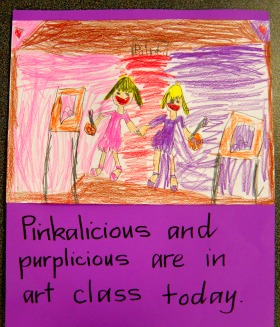
Whatever the explanation, the children’s love of books shone through at the end of the day. Yalanda couldn’t wait to show me her new  picture book, Purplicious (V. Kann, E. Kann). Capitalising on the moment, I read the book to the class and Yalanda drew about the story. I love her artwork – her characters are expressive and you almost see them move. 

Yalana’s drawing of her new book, ‘Purplicious’.

 Please leave comments

Does your school have Book Fairs?

What do you think about the results from this graph?

Should Book Fairs just sell books?