Sharing Early Literacy Learning Journeys

It’s mild and foggy as I head to the lake with camera in one hand and coffee in the other. The fog lifts, leaving a clear, sunny sky. Rounding the bend that leads to the lake an  amazing sight greets me: two large gaggles of geese are swimming on the lake in the distance. They are aware of me and start to swim away – but as they do, the gaggles come together, joining forces as it were, into one massive group – except they are not milling in a group, but stringing out in a long, long line.

Gaggle of geese in a line

Quickly I head behind the trees out of view of the geese. I race to the end of the lake for a closer look – and maybe some photos, despite their distance from shore.

I wonder why a group of five geese separates from the main string of geese. Are they the leaders? Are they on guard?
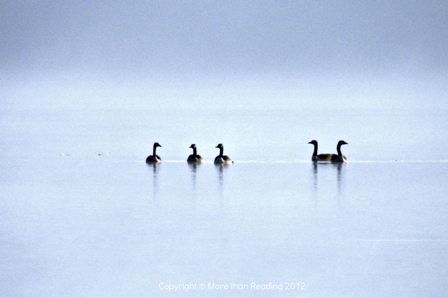
Five geese separate from the main group

The remaining group is large and the line is long. Too many geese to count from this far away. I watch and snap, snap, snap, moving along the strung out line of Canadian Geese. At the same time, the geese are slowly moving away.
Slowly, silently swimming, getting smaller and smaller. If they are aware of me, they are not afraid.

Suddenly, several geese honk in warning. I hear a splash in the water to my left – and wonder quickly if it’s a fish, a duck or an otter. To my disappoinment it’s a dog: a large, cream, labrador. He swims and cleans himself several times and then dog and master walk past. Meanwhile, the geese move further and further from shore… and photos fail to focus.

I turn and walk away, still smiling at my luck in seeing such a sight. I follow a narrow trail in the woods beside the lake – and I’m struck by another sight! This time, massive, dewy cobwebs sparkling in the sun. I stop. Sigh. And snap!
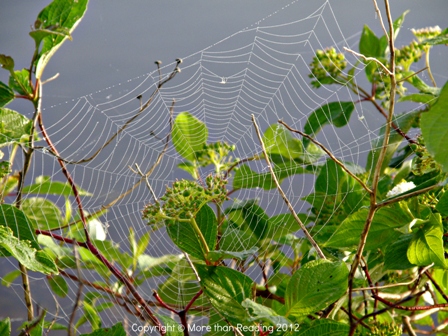
One of the many wonderful webs in the woods

And another web to gaze upon

The morethanreading blog is changing with my leave from full time Year One teaching. Like a child, I’m living in the moment – experiencing travelling and new environments. Interestingly, I also realise how much I am learning in the same way that my Year Ones learned – through Language Experience activities…

  • Participate and enjoy the experience
  • Talk about it, think about it
  • Take photos/or draw
  • Write and read about the experience/activity
  • Share
  • Read, research and make notes
  • Make photo stories
  • Share

On my way back for breakfast, two squirrels have breakfast. What a way to start the day!
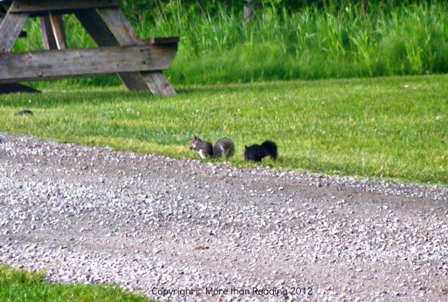
I didn’t know that black squirrels and grey squirrels met for breakfast!

And bounding up the hill from the lake I laugh to see an ‘h’ resting on the road. Maybe I can’t get away from school and children after all!
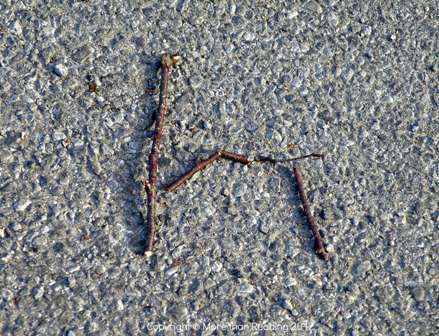
I couldn’t miss the ‘h’ on the road

What was the highlight of your day today?

Creating a nature photo story An April Alphabet got me thinking. Since being on leave, I’ve had the luxury of more time to explore my natural surrounds–to walk and wander on nearby beaches, fields, forests and trails–and to become more aware of letters (and numbers) in nature. I’m reminded of the times children brought in a curled up witchetty grub that looked like an ‘o’, a caterpillar lying straight on a leaf that looked like an ‘l’ and a stick in the shape of a ‘t’.

Finding letters in nature is a fun way for children to learn the look, names and sounds of letters.

Questions arise…
Some letters seem to appear more often than others, such as c, j, l, o, t, v and y. And I wonder why?

What are some of the letters made of?

Sticks:

The stick ‘r’ was found on the beach

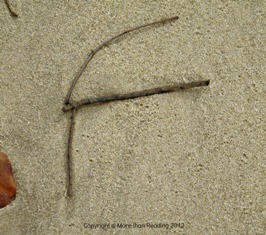
An ‘f’ was found on the beach sand, too

This ‘E’ was a special find on the beach

Leaves:

A gum leaf ‘c’ became a common find on treed paths and walkways

Plants and plant pieces:

‘l’ or ‘i’ was a frequent find after high tide

A ‘v’ spread onto the beach sand

Trees:

‘Y’ is easy to find in trees

And now for something different: worms

After rain, worms wriggle onto the driveway

What letters or numbers have you seen in your natural environment?

I made an alphabet. A photo alphabet. After an amble in the area in the afternoon. I downloaded the photos… and alphabet possibilities tumbled out:
b for blackbird, d for daffodil, e for evergreen, f for fungus….

A relevant alphabet. Meaningful. To me anyway.

Click here  to view my powerpoint, ‘April Alphabet’, (takes a few seconds to download).

And so to the classroom… Imagine the relevance of alphabet cards and alphabet books that you and the children make together – for use in your classroom.

Digital photos make literacy easy. Children suggest pictures for letters. Take the digital photos. Download. Add text. Print alphabet cards – or alphabet book. Use!

A friend emailed about a few children who struggle with letters and sounds. To help solve this problem, she has the children take the photos to make a class alphabet book (with her help). What a great idea!

She says, “On top of what I’m already doing, I’ll get these children to take photos to create our own class alphabet book.  It will be their project to present to the class.  I work with them for…  to create it and share it, then most importantly constantly refer back to it when they are struggling with the sounds.”

Such a group-made alphabet book is relevant to the children. Personal. Meaningful. About the children. Their classroom. Their school. Their community.

I’ve done this with children in two ways: drawings and digital photos.  After discussion, the children draw pictures to represent the letter, e.g. z for zucchini in a vegetable alphabet book; c for crocodile on animal alphabet cards. At other times, children suggest an object for each letter and I take the photos, e.g. c for computer, d for door, p for pencil.

Once, a six year old made A Car Alphabet by drawing a car with the name for each letter, A a for Alfa Romeo, B b for Buick, C c for Cadillac…. Guess what his main interest was at the time!

Early childhood classrooms usually have alphabet cards. These are on a word wall with additional word cards that the children use in their writing.

Alphabet cards as part of a word wall

Early childhood classrooms have alphabet cards for children to use when learning letter formations and phonics. These are beneath the whiteboard for proximity to the children – not above the board and out of reach.

A low alphabet for children to trace and touch

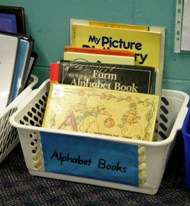
And of course, every classroom needs a basket of Alphabet Books.

Store alphabet books together for convenience

Have you made class alphabet books? How?

Saturday morning

In the backyard,
Looking for signs of spring.
Buds, leaves,
Dandelions, in the grass.
Suddenly…
A grey squirrel, in a tree,
Near the house.

Quiet. We look at him. He looks at us. He nibbles. On a bud… a seed… a pine cone? Hard to distinguish.

Whirr of the camera. He takes off. Down the tree. Over the grass. Scampering. Across the greenbelt. Running. To a big tree. Up, up, up. Way up. Climbing. Leaping. Branch to branch.  Stops. Nibbles again.

Photos. Thank goodness for digital photos that are easily deleted!
But, some turned out…

This slideshow requires JavaScript.

Do you know this poem?

The Squirrel

Whisky, frisky,
Hippity hop,
Up he goes
To the tree top!

Whirly, twirly,
Round and round,
Down he scampers,
To the ground.

Furly, curly
What a tail!
Tall as a feather
Broad as a sail!

Where’s his supper?
In the shell,
Snappity, crackity,
Out it fell!

Author unknown

Looking for information about squirrels?

Here’s a website about Squirrels simple, fun–and easy for children:  http://www.ofnc.ca/fletcher/our_animals/squirrels/grey-squirrels_e.php

Today is Earth Day. Let’s look at mother nature at work. Late March. Early April.
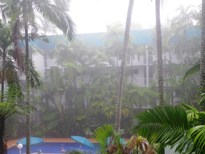
Sunday: torrential rains, high tides and wild waves.
Monday: torrential rains, high tides and wild waves.
What happened at the beach?

Torrential rains for several days

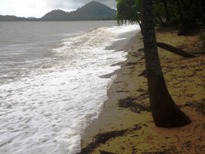
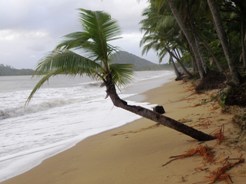
In the morning, high tides and pounding waves hit the foreshore. Note the location of the large palm trunk in the front and the heavily slanted, small palm trunk behind.

Tides and waves create a 'new' foreshore.

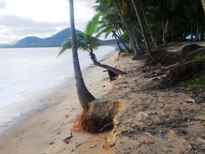
Tuesday morning. Destruction revealed. Beach sand washed away.

Now look at the front palm trunk and the slanted palm trunk!

One wonders:
How much beach sand has gone? How long will the teetering palm trees last?
Is this ‘natural’ erosion? Has it been helped and/or hastened by man?

And then…
More rain and high tides in April.

By mid April, more sand has washed away.

What will tomorrow bring?

Hooray! A happy ending. The sands come back…

Nature's way: beach sand comes back...

Time for a walk to learn the names of unknown trees and flowers.
Happy earth day, everyone. How will you celebrate?

In the last two blogs we talked about ‘words that work’. Then, a friend sent me this video about the power of words – and I wanted to share it. At well under 2 minutes, it’s nice and short.

You may need to turn up the volume to hear the words better…

Enjoy!

Last week’s blog asked, ‘What words work’ for early years’ teachers in shaping children’s behaviours? Here is the list so far, in alphabetical order… 17 ‘Words that work’:

Either/or…  “Either you keep your feet to yourself or you leave the group.”

Good choice…    “Are you making a good choice?” “Good choice?” “Poor choice?”

I like…     “I like your good listening.”

I like/love how you …..    makes praise more personal, and genuine

I like the way… “I like the way you are both co-operating at the blocks.”

O.T.T…. said quietly to the child as a reminder that an action is ‘Over The Top’.

Quality …     “That is quality work!”

Sandy (a child) is now the teacher… “Listen to her while she teaches you about a fantastic way to work the problem out.”

Sensational…  “SennnnnSATIONAL” – with hand actions. When someone does something special (sensational work or behaviours) tumble one hand over the other and end up in thumbs up position (whilst saying ‘sennnnnSATIONAL’)

Stop, look, listen…  with accompanying hand movements.  Always said slowly and clearly with the expectation that everyone will be doing each action as they are called.

Switch on…   help our bodies to be ‘switched on’ and ready to learn

Switch off…   things that cause us to ‘switch off’ learning

Thanks…  “Thanks for the tadpoles, Tom.”  “Hats… and to the door, thanks.”

Choice…   “It’s not a choice.”  “Wearing shoes in not a choice.”

Negotiable… “This is not negotiable!”

When…  and then…  “When you have finished xyz then you can do abc.”

You did it!     Reinforce or celebrate when a child does a skill correctly; if he fixed something by himself or with little help. The child often excitedly says, “I did it!” on realizing his accomplishment.

Once again, ‘Thanks’ to the early years teachers, parents and Speech Language Pathologist who kindly took the time to share their ‘Words that work.’ 

Let’s continue the learning journey. Feel free to share more ‘words that work’ in the comments box below. The more the merrier!

In my last blog ‘What words work for you?  Shaping children’s behaviours in your early years classroom’ I mentioned that one of my favourite ‘words that work’ is ‘Thanks’… as in… “Close the door. Thanks.” Upon reflection, I thought it may be helpful to explain that I use ‘Thanks’ in this context because I am expecting that the door WILL be closed — it is not a choice, it is not a ‘please’, it is not a ‘can you?’.

I also use ‘Thanks’ to show appreciation and gratitude… as in… ‘Thanks for bringing the green tree frog, Alistair,’ or ‘Thanks for the great idea, Hilary’.

‘Thanks is always positive.

Lastly, ‘Thanks’ to those early years teachers who have kindly taken the time to share their ‘Top 3 Words that work.’

Do you have 3 favourite ‘words that work’ to add to the list before it is compiled and published on Thursday?