Weekly Photo Challenge: Changing Seasons
Changing seasons.
From fall to winter.
From coloured, autumn leaf to wintry, white leaf.
Brown, oak leaf stark in fresh, fluffy snow.
Winter in Canada.
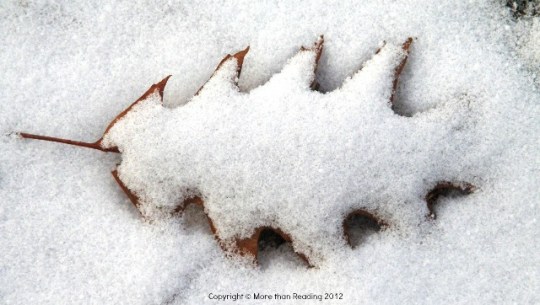
Photo taken 25.11.2012

Changing seasons.
From fall to winter.
From coloured, autumn leaf to wintry, white leaf.
Brown, oak leaf stark in fresh, fluffy snow.
Winter in Canada.
Photo taken 25.11.2012
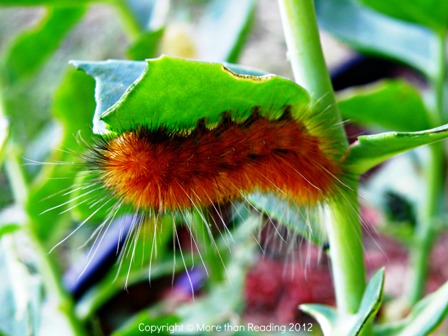 This is the woolly bear that eats the sedum that lives in the garden that lies at the side of the house.
 This is the golden woolly bear that eats the green sedum that lives in the small garden that lies at the north side of the house.
 This is the bunch of woolly bears and golden woolly bears that feast on the green sedum leaves that live in the small, window garden that lies at the cool, north side of the house (How many caterpillars? How many nibbled leaves can you see?)
 This is the jar for the golden and woolly bears that eat the green sedum leaves that live in the small, window garden at the cool, north side of the house.
 This is the soft, golden cocoon that is spun by the golden woolly bear that is now in the glass jar with the silver-green sedum leaves that come from the small, window garden at the cool, north side of the house.
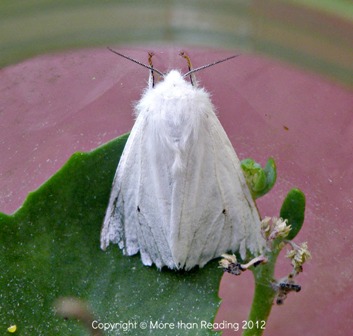 This is the back of the small, white moth that comes from the golden cocoon after its two weeks in the glass jar with the green sedum leaves that come from the small, window garden at the cool, north side of the house.
 This is the front of the small, white moth that comes from the fuzzy cocoon after its two weeks in the glass jar with the green sedum leaves that come from the small, window garden at the cool, north side of the house.
 And this is the sedum that lives in the garden that lies at the north side of the house – that the moth’s eggs may hatch in so that woolly bear caterpillars can devour the leaves once again…
With thanks to the writer of the the Nursery Rhyme and cumulative story, This is the House that Jack Built.
“When a pine needle falls in the forest;
the eagle hears it,
the deer sees it, and
the bear smells it.”
…an old First Nations saying.
“Look! Down the end of the road,” shouts our neighbour.
Straining our eyes and peering into the distance we see a smudge of brown against the grassy slope.

Suddenly a car noise. The deer turns sharply to take off back into the forest.
It’s hard to focus the camera.
A few minutes after the car passes, the deer reappears. Crosses the road towards the opposite green belt, stops.
A long way away. Three hundred metres at a guess. I steady the camera against the big, blue spruce at the front of the house. Try for another photo. Digital zoom. Focus.
Not perfect. But the best I can do. The deer moves off. Into the trees.
I walk down the road. Quietly. Slowly. Optimistically. Hoping the deer may stop to browse on willow leaves.
No luck. No deer. Maybe she saw me, smelled me, heard me.
Later that day, a neighbour asks if we saw a fawn running up the greenbelt next to our house and I wonder if the fawn belonged to the deer we saw earlier at the end of the road.
No. Missed it. I was inside folding laundry!
“Hey Honey. Grab your camera. Will’s got a bird at his front door.”
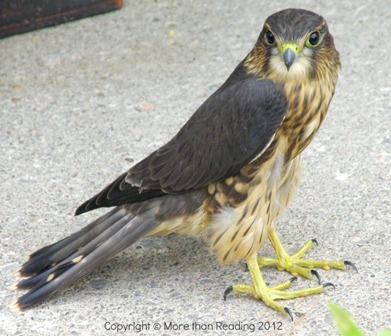
For the second time in four days. A photo opportunity. And a learning opportunity. Excitedly I cross the road and see a small hawk on the lawn.
Is his wing broken?

He struggles and flaps his wings trying to get away from the admiring humans. He runs towards the open garage but stops on nearby bags of soil –
a higher vantage point perhaps?

Note the strong, sharp talons!
From there, he walks to the patio, watching us all the time.
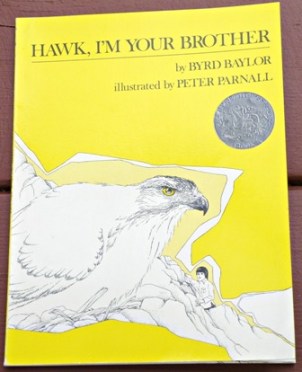
I see his sharp, hooked beak and his ‘fierce, free eyes’ – as Byrd Baylor (1976) describes Rudy Soto’s hawk in Hawk, I’m Your Brother.
I see a droopy left wing, stopping him from flying as a hawk is meant to fly: soaring, gliding, diving…

One last photo, then we leave him in peace…
I phone and leave a message at a wildlife centre to see what we should/could do with a young hawk with a possible broken wing.
An hour later the hawk goes from Will’s front yard. When he leaves and where he goes, we do not know. It’s up to Mother Nature now…
As for me…
I re-read and relish Byrd Baylor’s wonderful book, Hawk, I’m Your Brother.
I also aim for ‘just-in-time-learning’.
I look up ‘hawks’ in the index of A Guide to Field Identification, Birds of North America (1966) by Robbins, Bruun and Zim and flip through sixteen pages of vultures, hawks and falcons (all of whom are in Order Falconformes) and learn that they are ‘diurnal flesh eaters and most take live prey.’ In addition, they ‘all have a heavy, sharp, hooked bill, and toes with strong curved talons’ (p. 64). However, I am not sure which hawk this one is…
I Google. But there are many, many choices…
I’ll settle for ‘hawk’ for the time being!
“Hey, Honey. Get your camera. Come out here. Quick!” my husband calls.
I grab my camera and race out the sliding doors onto the back deck. In the middle of the right hand side of the back lawn sits a snapping turtle – about a foot across the shell.
A rounded, grey head protrudes from her shell – not tucked within as I have seen with other turtles – and her triangular, spiked tail sticks out the back.

Old neck folds wrinkle and gather between her head and shell.

Four grey, scaly legs protrude from the shell and get lost in the grass – ready to be cut. In fact, Bill was cutting the grass when he saw her…
We look. From front, back and sides. Grey, muddy shell. Almost smooth. Unclear markings. Round head. Not pretty. Pre-historic. Zig-zag edge at the back of her shell, from which a ‘dinosaur-like’ scaled, tail protrudes.
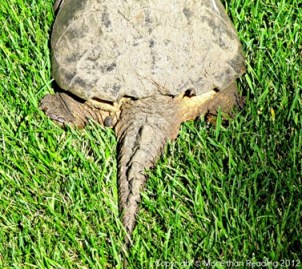
She is plopped on the ground – and looks at us. Alert. Wary. Sand is in her right eye and she rubs her right front leg across her eye as if to clear it: “All the better to see you with, my dear!”
Why is this snapping turtle on our back lawn?
Where has she been?
Where is she going?
We assume she laid eggs (in the greenbelt woodland area behind? under our back cedar trees?) and is now returning to the lake 200-300 yards in front of us… in an easterly direction.
I stop taking photos and retreat to the back deck. Give her space.
Soon, she rises slowly and walks. Lumbers really. In a straight line between our house and a neighbour’s house – no fences here. Makes it easy for her… slow and steady wins the race.

Seeing the snapping turtle heading for water reminds me of Lynley Dodds’ book (1985), The Smallest Turtle when turtle babies hatch on the beach and hear the water calling: “To the sea! To the sea!” with illustrations of hatchlings racing, stumbling and scrambling over the hot, white sand to the cool, clear sea… racing to avoid being picked off by seagulls overhead.
I run to the front of the house and peek around the corner. She’s lumbering with a steady gait, rhythmical, almost swinging. Not ungainly. Each time she sees me, she plops and stops.
I hide. She continues walking on the grass. Two neighbours come to look. She plops again. Head moving. Watching us. Each time we move out of sight, she walks – but the minute she sees one of us, she plops!
How wide is her peripheral vision?
Finally, we let her go. To get on with her task. Her walk. I hope she accomplishes her mission and reaches her destination… but first, there’s a road to cross.
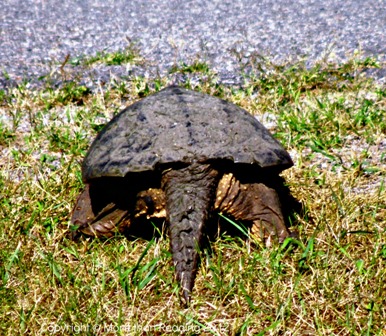
From behind a low juniper tree I watch her traverse the ditch by the side of the road and go onto the road. Steadily, rhythmically and safely she strides across the bitumen, with speed it seems – no cars come along at the time. Maybe the hard surface is easier to walk on than soft grass and ground?
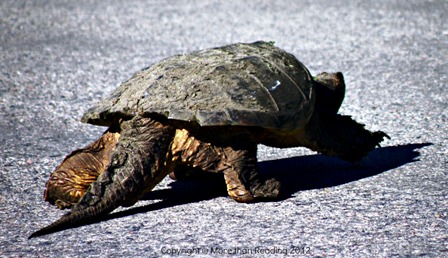
She goes up the ditch on the other side of the road, onto a neighbour’s grass. I watch her until she’s out of sight; swallowed by shadows of distant trees. Three more lawns to go, a small road, woods and then the lake…
I hope she makes it!
No wonder these signs are on highways around here.

This is the first snapping turtle I have ever seen, so I want to find out about it. ‘Just in time learning’ I call it – learning when one needs it. When information is meaningful and relevant.
How much learning in your classroom is ‘just in time learning’?
When children bring tadpoles, caterpillars, a green tree frog, a butterfly, a bird’s nest or almost anything from nature, we take the time to look, talk and share – both knowledge and experiences. Sometimes, the shared item grows into a ‘mini-unit’ or a ‘short study’ with drawings, photos, sentences, vocabulary, sounds, word work, writing and reading. And, there’s always research… books, charts and internet. ‘Strike while the iron’s hot’. ‘Just in time learning’ occurs for children and adults. We learn interesting things together.
Later, I find out that a snapping turtle’s plastron is ‘yellowish, small and cross-shaped: legs and underbelly are not well protected’ (http://torontozoo.ca).
But I had to look up the word, plastron: the under portion of the shell of a turtle or tortoise that is made up of several, often hinged, bony plates joined to the carapace by bridges located between the animal’s legs (Encarta Dictionary).
Learn more about snapping turtles: http://torontozoo.ca/AdoptAPond/turtles.asp
It’s mild and foggy as I head to the lake with camera in one hand and coffee in the other. The fog lifts, leaving a clear, sunny sky. Rounding the bend that leads to the lake an amazing sight greets me: two large gaggles of geese are swimming on the lake in the distance. They are aware of me and start to swim away – but as they do, the gaggles come together, joining forces as it were, into one massive group – except they are not milling in a group, but stringing out in a long, long line.

Gaggle of geese in a line
Quickly I head behind the trees out of view of the geese. I race to the end of the lake for a closer look – and maybe some photos, despite their distance from shore.
I wonder why a group of five geese separates from the main string of geese. Are they the leaders? Are they on guard?
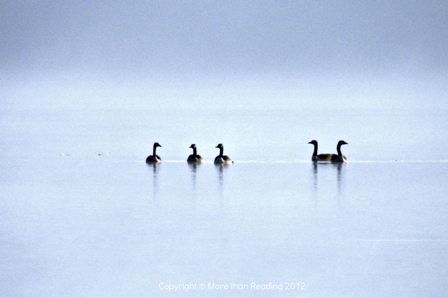
Five geese separate from the main group
The remaining group is large and the line is long. Too many geese to count from this far away. I watch and snap, snap, snap, moving along the strung out line of Canadian Geese. At the same time, the geese are slowly moving away.
Slowly, silently swimming, getting smaller and smaller. If they are aware of me, they are not afraid.
Suddenly, several geese honk in warning. I hear a splash in the water to my left – and wonder quickly if it’s a fish, a duck or an otter. To my disappoinment it’s a dog: a large, cream, labrador. He swims and cleans himself several times and then dog and master walk past. Meanwhile, the geese move further and further from shore… and photos fail to focus.
I turn and walk away, still smiling at my luck in seeing such a sight. I follow a narrow trail in the woods beside the lake – and I’m struck by another sight! This time, massive, dewy cobwebs sparkling in the sun. I stop. Sigh. And snap!
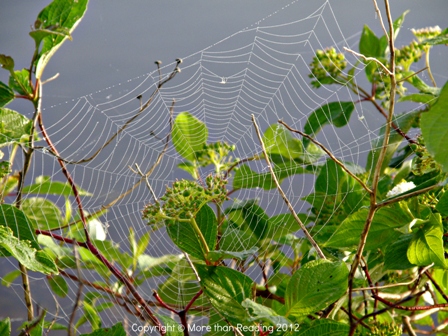
One of the many wonderful webs in the woods

And another web to gaze upon
The morethanreading blog is changing with my leave from full time Year One teaching. Like a child, I’m living in the moment – experiencing travelling and new environments. Interestingly, I also realise how much I am learning in the same way that my Year Ones learned – through Language Experience activities…
On my way back for breakfast, two squirrels have breakfast. What a way to start the day!
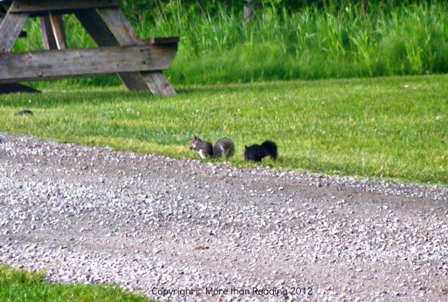
I didn’t know that black squirrels and grey squirrels met for breakfast!
And bounding up the hill from the lake I laugh to see an ‘h’ resting on the road. Maybe I can’t get away from school and children after all!
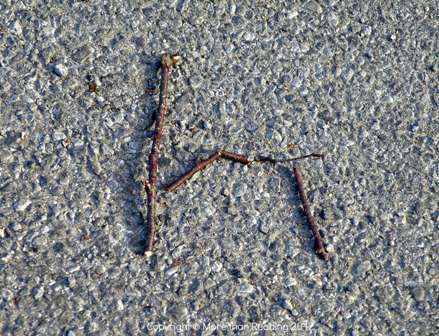
I couldn’t miss the ‘h’ on the road
Creating a nature photo story An April Alphabet got me thinking. Since being on leave, I’ve had the luxury of more time to explore my natural surrounds–to walk and wander on nearby beaches, fields, forests and trails–and to become more aware of letters (and numbers) in nature. I’m reminded of the times children brought in a curled up witchetty grub that looked like an ‘o’, a caterpillar lying straight on a leaf that looked like an ‘l’ and a stick in the shape of a ‘t’.
Finding letters in nature is a fun way for children to learn the look, names and sounds of letters.
Questions arise…
Some letters seem to appear more often than others, such as c, j, l, o, t, v and y. And I wonder why?
What are some of the letters made of?
Sticks:

The stick ‘r’ was found on the beach
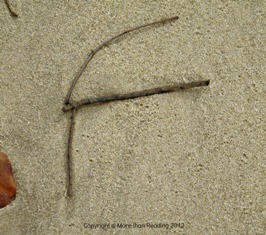
An ‘f’ was found on the beach sand, too

This ‘E’ was a special find on the beach
Leaves:

A gum leaf ‘c’ became a common find on treed paths and walkways
Plants and plant pieces:

‘l’ or ‘i’ was a frequent find after high tide

A ‘v’ spread onto the beach sand
Trees:

‘Y’ is easy to find in trees
And now for something different: worms

After rain, worms wriggle onto the driveway
I made an alphabet. A photo alphabet. After an amble in the area in the afternoon. I downloaded the photos… and alphabet possibilities tumbled out:
b for blackbird, d for daffodil, e for evergreen, f for fungus….
A relevant alphabet. Meaningful. To me anyway.
Click here to view my powerpoint, ‘April Alphabet’, (takes a few seconds to download).
And so to the classroom… Imagine the relevance of alphabet cards and alphabet books that you and the children make together – for use in your classroom.
Digital photos make literacy easy. Children suggest pictures for letters. Take the digital photos. Download. Add text. Print alphabet cards – or alphabet book. Use!
A friend emailed about a few children who struggle with letters and sounds. To help solve this problem, she has the children take the photos to make a class alphabet book (with her help). What a great idea!
She says, “On top of what I’m already doing, I’ll get these children to take photos to create our own class alphabet book. It will be their project to present to the class. I work with them for… to create it and share it, then most importantly constantly refer back to it when they are struggling with the sounds.”
Such a group-made alphabet book is relevant to the children. Personal. Meaningful. About the children. Their classroom. Their school. Their community.
I’ve done this with children in two ways: drawings and digital photos. After discussion, the children draw pictures to represent the letter, e.g. z for zucchini in a vegetable alphabet book; c for crocodile on animal alphabet cards. At other times, children suggest an object for each letter and I take the photos, e.g. c for computer, d for door, p for pencil.
Once, a six year old made A Car Alphabet by drawing a car with the name for each letter, A a for Alfa Romeo, B b for Buick, C c for Cadillac…. Guess what his main interest was at the time!
Early childhood classrooms usually have alphabet cards. These are on a word wall with additional word cards that the children use in their writing.

Alphabet cards as part of a word wall
Early childhood classrooms have alphabet cards for children to use when learning letter formations and phonics. These are beneath the whiteboard for proximity to the children – not above the board and out of reach.

A low alphabet for children to trace and touch
And of course, every classroom needs a basket of Alphabet Books.
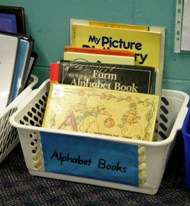
Store alphabet books together for convenience



 More than Reading Blog