Sharing Early Literacy Learning Journeys

Archive for the ‘Early literacy’ Category

This is the woolly bear that eats…

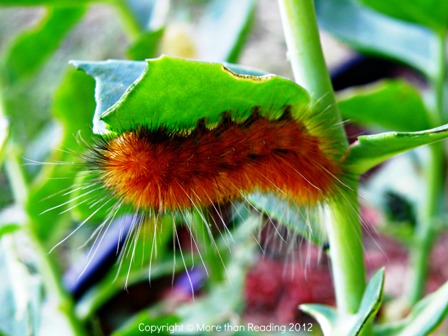
This is the woolly bear that eats the sedum that lives in the garden that lies at the side of the house.

This is the golden woolly bear that eats the green sedum that lives in the small garden that lies at the north side of the house.

This is the bunch of woolly bears and golden woolly bears that feast on the green sedum leaves that live in the small, window garden that lies at the cool, north side of the house (How many caterpillars? How many nibbled leaves can you see?)

This is the jar for the golden and woolly bears that eat the green sedum leaves that live in the small, window garden at the cool, north side of  the house.

This is the  soft, golden cocoon that is spun by the golden woolly bear that is now in the glass jar with the silver-green sedum leaves that come from the small, window garden at the cool, north side of  the house.

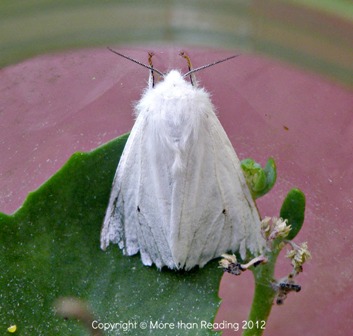
This is the back of the small, white moth that comes from the golden cocoon after its two weeks in the glass jar with the green sedum leaves that come from the small, window garden at the cool, north side of  the house.

This is the front of the small, white moth that comes from the fuzzy cocoon after its two weeks in the glass jar with the green sedum leaves that come from the small, window garden at the cool, north side of  the house.

And this is the sedum that lives in the garden that lies at the north side of the house – that the moth’s eggs may hatch in so that woolly bear caterpillars can devour the leaves once again…

With thanks to the writer of the the Nursery Rhyme and cumulative story, This is the House that Jack Built.

10for10 Special Picture Books


What are ten of your favourite picture books for your classroom or library? Thanks to @mandyrobek and @CathyMere we can share ten favourite picture books on Blogs and Twitter today: #PB10for10. Here are ten special books that I love to share with children – in no particular order.
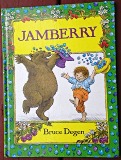
 Jamberry by Bruce Degen (1983) is a hugely enjoyable book with rollicking rhyme and rhythm – I can’t help but ‘sing-a-long’ to the words. Children pick up on the rhythmical language and join in. Colouful, clear illustrations and expressions of the characters add to the fun. A book to read and re-read!
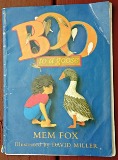

Boo to a Goose by Mem Fox (1996) is also rhythmical, giving children a sense of rhyming words – great for beginning readers. Bright, clear illustrations add clarity to the sentences and a repetitive refrain invites children to join in. The big print enables children to easily see the text and participate in shared reading.
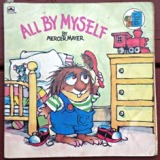

All by Myself by Mercer Mayer  (1983) is one of Mercer’s many delightful, kid-friendly books that are funny and easy for developing readers. The clear, expressive illlustrations enhance the simple language and messages. All by Myself is valuable for beginning readers with the repetitive sentence starter of ‘I can…’ and child-like actions. A funny book to also help children’s writing!
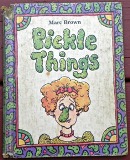

Pickle Things by Marc Brown (1980) is a funny rhyming book.  The bold pictures illustrate the crazy sentences as in: Pickle things you never make… like pickle pie and pickle cake. Pickle donuts, pickle flakes. Children laugh out loud at the absurdity of the pickle suggestions and uses. Big print and few words per page also help developing readers. A one-of-a-kind book!
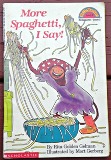

More Spaghetti, I Say by Rita Golden Gelman (1977) is loads of fun for children with its child-like antics and responses. The rhyme, rhythm and enlarged text make it a sought after book for developing readers. Clear, expressive illustrations add to the hilarity of the story. Laugh out loud!


Handa’s Surprise by Eileen Browne (1994) is a superbly illustrated storybook with bright colours, fruits and animals of hot Africa. The simple and thoughtful story in words is enhanced by clear illustrations that tell another story… which is indeed a surprise. A real gem!


little blue and little yellow by Leo Lionni was published in 1959, but notions of friendship, co-operation and tolerance are still relevant.  The message is clear – told in direct sentences and accompanying sparse ‘blobs’ of colour.  A delight!


A Fish out of Water by Helen Palmer (Suess Beginner Book, 1983) is a favourite with children because they identify with the boy’s actions that cause the problem –  starting small and getting bigger all the time. Children are enthralled by the unfolding catastrophes – in words and illustrations!


Mr Archimedes’ Bath by Pamela Allen (1980) is a funny story that makes children think, wonder and try to solve the water problem. It’s a good book to include in any unit of work or study on ‘Water’. The animals in the illustrations keep their skin/fur on but Mr Archimedes is naked, which adds to children’s guffawing and laughter. A literary book for ‘integration across the curriculum’.
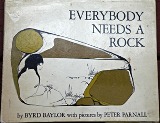

Everybody Needs a Rock by Byrd Baylor (1974) is a favourite of mine – although a bit long for some children. Baylor gives ten apt and often amusing rules for finding your own special rock. The poetic words are accompanied by Peter Parnall’s sparse, expressive illustrations that perfectly depict the rule. An absolute joy!

On reflection, I see that many of these books are ‘old’ favourites – but still exciting and memorable picture books to enjoy with young children. Maybe you can find some of them to enjoy too!

Alphabet Letters in Nature

Creating a nature photo story An April Alphabet got me thinking. Since being on leave, I’ve had the luxury of more time to explore my natural surrounds–to walk and wander on nearby beaches, fields, forests and trails–and to become more aware of letters (and numbers) in nature. I’m reminded of the times children brought in a curled up witchetty grub that looked like an ‘o’, a caterpillar lying straight on a leaf that looked like an ‘l’ and a stick in the shape of a ‘t’.

Finding letters in nature is a fun way for children to learn the look, names and sounds of letters.

Questions arise…
Some letters seem to appear more often than others, such as c, j, l, o, t, v and y. And I wonder why?

What are some of the letters made of?

Sticks:

The stick ‘r’ was found on the beach

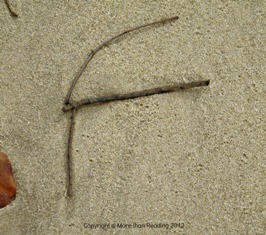
An ‘f’ was found on the beach sand, too

This ‘E’ was a special find on the beach

Leaves:

A gum leaf ‘c’ became a common find on treed paths and walkways

Plants and plant pieces:

‘l’ or ‘i’ was a frequent find after high tide

A ‘v’ spread onto the beach sand

Trees:

‘Y’ is easy to find in trees

And now for something different: worms

After rain, worms wriggle onto the driveway

What letters or numbers have you seen in your natural environment?

An April Alphabet

I made an alphabet. A photo alphabet. After an amble in the area in the afternoon. I downloaded the photos… and alphabet possibilities tumbled out:
b for blackbird, d for daffodil, e for evergreen, f for fungus….

A relevant alphabet. Meaningful. To me anyway.

Click here  to view my powerpoint, ‘April Alphabet’, (takes a few seconds to download).

And so to the classroom… Imagine the relevance of alphabet cards and alphabet books that you and the children make together – for use in your classroom.

Digital photos make literacy easy. Children suggest pictures for letters. Take the digital photos. Download. Add text. Print alphabet cards – or alphabet book. Use!

A friend emailed about a few children who struggle with letters and sounds. To help solve this problem, she has the children take the photos to make a class alphabet book (with her help). What a great idea!

She says, “On top of what I’m already doing, I’ll get these children to take photos to create our own class alphabet book.  It will be their project to present to the class.  I work with them for…  to create it and share it, then most importantly constantly refer back to it when they are struggling with the sounds.”

Such a group-made alphabet book is relevant to the children. Personal. Meaningful. About the children. Their classroom. Their school. Their community.

I’ve done this with children in two ways: drawings and digital photos.  After discussion, the children draw pictures to represent the letter, e.g. z for zucchini in a vegetable alphabet book; c for crocodile on animal alphabet cards. At other times, children suggest an object for each letter and I take the photos, e.g. c for computer, d for door, p for pencil.

Once, a six year old made A Car Alphabet by drawing a car with the name for each letter, A a for Alfa Romeo, B b for Buick, C c for Cadillac…. Guess what his main interest was at the time!

Early childhood classrooms usually have alphabet cards. These are on a word wall with additional word cards that the children use in their writing.

Alphabet cards as part of a word wall

Early childhood classrooms have alphabet cards for children to use when learning letter formations and phonics. These are beneath the whiteboard for proximity to the children – not above the board and out of reach.

A low alphabet for children to trace and touch

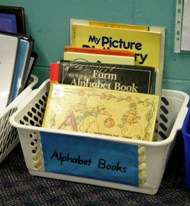
And of course, every classroom needs a basket of Alphabet Books.

Store alphabet books together for convenience

Have you made class alphabet books? How?

What words work for you? Shaping behaviours in your early years classroom…

Shirley and I are supervising 50 children from our two classes on the verandah as they eat lunch and put lunchboxes away. Some children are sitting, waiting for the bell. Jaydeen is pushing her friend and shouting. It’s a situation early years teachers often encounter. How should we react? What words work at times like this? Do some words work better than others?

The answer plays out in front of me…

“Jaydeen. OTT,” says Shirley quietly. Jaydeen looks sheepishly at her teacher, then sits down with classmates ready to go out for play.

“Wow. That works well, Shirley. What’s OTT?” I ask.
Shirley smiles and replies, “Over The Top.”
I turn to her and nod, “I could try that…”

Shirley’s acronym, OTT  and words ‘Over The Top’ are new to me. They are simple and they work. I like her words and I like her calm, positive tone as she uses ‘words that work’ for her, to shape Jaydeen’s behaviour.

I call them ‘words that work’ —words that get the desired result, quickly, effectively and with minimal fuss and muss.

What are the top 3 ‘words that work’ for me in shaping children’s behaviour?

Top 3  ‘Words that work’  for me:

Thanks                         …as in, ‘Close the door. Thanks.’

Quality                          …as in,That’s quality work.’

Either/Or                    ‘Either keep your hands to yourself, or leave the group.’

Whether you are grappling with inappropriate behaviours, or nurturing good behaviours into even better ones, I wonder ‘what words work’ particularly well for you?

In the comments box, tell us about the top 3 ‘words that work’ for you.
I know we also use gestures, sounds etc. to shape behaviours, but for now let’s stick to words that work for you. It could be an acronym like Shirley’s, a phrase or two words. It doesn’t matter. Let’s share and learn together.

I’ll compile the list of ‘words that work’ and publish them so you can pick and choose ones that work for you.

Tweet this post, like it on Facebook, e-mail it to your friends, so we can share as many ‘words that work’ as possible by the end of January.

I hope your first week back is going well.

A find: two more ‘Grug’ books

Saturday afternoon. I’m in the shopping centre to meet friends for coffee at Myer’s. To talk teaching. We do this periodically. I’m early. I bypass pots, pans and platters. I gravitate to books. Children’s books. I’m amazed at the increased number of ‘early learning’ books that are tightly packed onto the shelves.  Books about the alphabet. Numbers. Colours. Shapes.

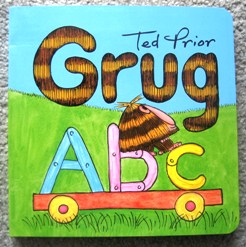
Spot a familiar character. Grug, face out on the shelf. But I don’t know these two books: Grug Abc and Grug 123 Numbers. I pick them up and turn the board pages.

Aahh… Ted Prior’s simple, colourful illustrations in the alphabet book. Clear, black text. Perfect for beginning readers! A Christmas gift idea?

Grug Abc is new to me!

Number book. One big red apple. Two yellow flowers. Five balancing rocks. Eight tall trees. The colourful, precise and thoroughly delightful Prior illustrations are familiar. Perfect for counting by ones and one-to-one correspondence. Another gift idea?

The familiar 'Grug' is on each double page

I immediately think of our basket of Grug books at school.

Our basket of Grug books - accessible all year.

I love Grug books

I love Grug books because of the simple, humorous story lines and the appealing, uncluttered illustrations. I love reading them to my Year Ones. We have fun. And the children laugh out loud!

There’s another reason I love Grug books; they are ‘easy’ to read for children who are on their way to reading. There are challenging words in these books but children’s familiarity with the stories and the clear illustrations make it easy for them to read the picturesread the words and re-tell the storiesGrug Goes Fishing is one of the funniest – and one my favourites.

A page from the book...'Grug began to fish.'

A book for all seasons

Grug books were first published in the eighties. Each Year One class I’ve had since then, loved Grug books. Our basket of Grug books stays in the classroom all year because children who enter Year One as readers, can read Grug.
And as other children grow into readers, they read Grug. A book for all seasons!

My 10 ‘must have’ picture books

Grug is on my list of 10 ‘must have’ picture books for my Year One classroom. You’ll find my top 10 list and synopsis of each book here.
Print the list off, put it on your fridge and share it with your friends.

Book Week with a Book Parade

Last week in Australia, we celebrated Book Week. We read short-listed books and winning books from the Younger Readers and Early Childhood Books Categories. I know how we early years teachers (and parents) are always looking for good books for our children, so in this blog you’ll find photos and my descriptions of 3 books that my Year Ones particularly enjoyed. And for those of you who enjoy quizzes, there’s a skill testing question for you in the caption under a child’s drawing in the Book Parade section. Enjoy!

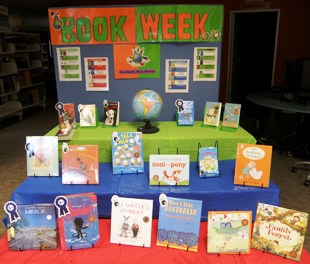
Book Week Books displayed in the Library

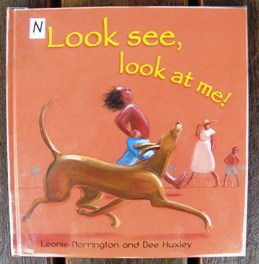
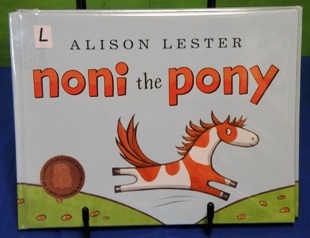
My class especially loved Look see, look at me, The Tall Man and Twelve Babies and Noni the pony.

Perfect for toddlers – and early readers!

Look see, look at me! is perfect as a read aloud for toddlers  – and ideal for early readers. I like to have any number of  ‘easy to read’ books in my Yr 1 classroom at the start of the year because they provide reading materials for beginning readers – without being ‘levelled books’.

'The Tall Man and the Twelve Babies'

The Tall Man and the Twelve Babies was appealing and funny. The children loved how the babies were all called Aliastair or Charlene. They laughed at the thought of the all the babies laughing together – and all crying together! They loved how the babies had mashed bananas for breakfast and mashed potatoes for tea. One girl commented that the cat was eating the mashed potato – so where was the 12th baby?

'noni the pony': an appealing book in rhyme

Noni the pony is rollicking and rhythmical with a simple storyline that was fun for the group. One boy liked the way the dog was similar in colour to the pony and blended in when Noni protected the dog and the cat. Others laughed at the cows watching Noni dance. “What is spooked?’ asked another – so a discussion of ‘scary’ words ensued.

On Wednesday morning we had our P-3 Book Parade:

Children dressed up as their favourite book characters. I was Little Red Riding Hood.

The witch from ‘Room on the Broom’ appeared

Who are the book characters in this girl's drawing? Place your answers in 'comments'.

A Book Worm cake was part of the celebrations too.

A 'Book Worm' cake was part of the celebrations too!

How did you celebrate Book Week?

10 for 10: My ‘must have’ picture books

What are the  ‘must have’ picture books in your classroom and library?  10 favourite picture books shared on blogs via Twitter on August 10 was instigated by @mandyrobek and @CathyMere – check #PB10for10.  Here is my list of ten special picture books  that I must have in my Year One classroom and library.

1. Where is the Green Sheep? by Mem Fox is a beginning year favourite. Lyrical and rhythmical language swings right along and whimsical, colourful illustrations add to its appeal. It’s a great book that helps ‘learning to read’ children.

2. Chicka Chicka Boom Boom by John Archimbault is a rollicking good read with alphabet letters never being so much fun.  Colourful illustrations add to the light and bright feel of the book as children easily sing along  – again and again.

3. No David  by David Shannon is a special favourite with my classes because it’s funny. Young children identify with David’s antics and his mother’s reactions. Every year I have at least one child learn to read from this book.

4. Just for You by Mercer Mayer is a gem. Contrasts between the character’s intentions and the end results are funny and ‘sketchy’ illustrations add to the hilarity.  Children love looking for the spider and the cricket, too. 

5. Titch by Pat Hutchins is a delightful story of a youngest child who never quite catches up to his sister and brother – until the end.  The direct language, simple storyline and clear illustrations make it another good choice for ‘starting the year’.

6. The Potato People by Pamela Allen is a moving story for some children with Jack and his mum leaving for a time, putting an end to Jack and Grandma’s fun-filled Fridays. The potato people know sorrow too… Seize the moment and have children make their own potato people.

7. Grug  by Ted Prior is a delightful character who grows from a tree and makes a home in a deserted burrow on a grassy hillside. Children laugh out loud at his wayward adventures that are often accompanied by hilarious illustrations.

8. Giraffes Can’t Dance by Giles Andreae, is a wonderful story that provokes and inspires. The lyrical, rythmical language and colourful, expressive illustrations add to its charm.

9. Horton Hatches the Egg by Dr Suess is still a favourite with the rhythmical language and endless appeal of Suess illustrations. Despite the length for young children, we always go home happy, 100%.

10. Go, Dog, Go by P. D. Eastman is a classic that still has children laughing and talking about the dogs in fast cars and the hilarious dog party.

Listing ten favourite books is easy… stopping at ten is the hard part!

Several of my favourite authors are listed here and I like many of their books.  Mem Fox is a favourite and choosing between Where is the Green Sheep? Koala Lou, Hello Baby, Boo to a Goose and Possum Magic is difficult. Pamela Allen, Pat Hutchins, Mercer Mayer, Dr Suess… how does a person choose ‘just one’ of their books?

Maybe we need a list of favourite authors with lists of all their books you love!

What are your 10 favourite picture books for young children?