Sharing Early Literacy Learning Journeys

Early Monday morning. Cool 10C. Cloudy. Dull. Grey. Intermittent light rain. Slow start today.  Curl up on the living room couch. Sip vanilla hazelnut coffee. Gaze out the picture window at a small wood bird-feeder in the front garden. Framed by two dwarf Alberta spruce trees. Chickadee arrives. A black-capped chickadee with ‘black cap, black bib and white cheeks’ (Peterson, p. 119).
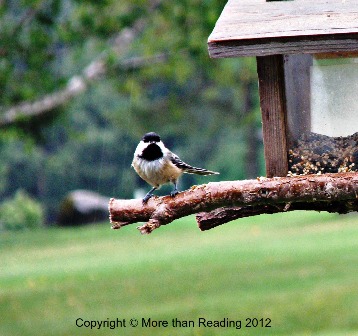
Chickadee feeds. On niger seeds. And a mixture of other small seeds. Feeds again. Zings to a big, blue spruce tree nearby.  Another small bird lands on the cedar perch.
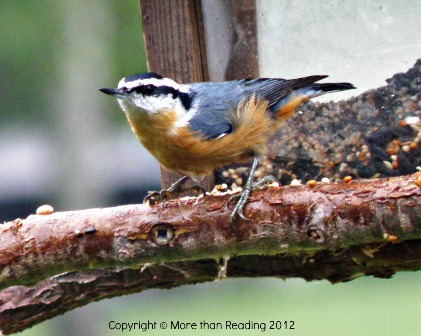
Pecks at seeds. Red-orange breast feathers – some might say cinnamon. Blue-grey back and wing  feathers. Black and white stripes at head.
New bird on the block! What is it?
Flies frantically  fast over the roof of the house. Chickadee returns. Leaves immediately when the ‘new’ bird appears. Heirachy is established.

Reach for the bird books. In the old, black, barrister bookcase – handed down through the family. Part of our large home library. Organised. Know exactly where to look. Second shelf from the top. Next to wood heat, wilderness and trees. Open the bird book. Look for the name of  the ‘new’ bird. In the chickadee family? Wren family? Finch family? Search the index.

Reminds me of classroom life. Searching for information about Harry’s frog. A green frog. Children observing and describing the frog. Sharing what they know. Getting frog books from the frog ‘basket of books’. Thinking aloud and demonstrating ‘finding information’. Going to the index. Looking up names. Green frogs. Tree frogs. White-lipped green tree frog.  That could be it. Turning to p.25. Reading headings. Finding out…

Do the same with the bird book. Search the index. Look up names. Examine colourplates and written descriptions. A nuthatch?

A nuthatch is a ‘small, chubby tree-climber, with a long bill and a stubby tail’ (Peterson, p. 120).  Is that a long bill? The bird nudges the small seeds around with his pointy beak as if he’s searching for a particular seed. Many seeds drop to the green grass below.

More information. Reddish breast. ‘Black line through eye’ (Peterson, Plate 44). Definitely a black stripe through his eye. Is that it?  A red-breasted nuthatch?

This nuthatch is skittish. He pecks and quickly turns his head from side to side. Constantly looking round… for enemies, I suppose. Blue Jays? Red-tailed hawks? Humans?

In the next half hour, we see two black-capped chickadees and the red-breasted nuthatch taking turns at the bird-feeder. Two small, brown sparrows also come and go. We take photos – but the birds are fast! Chickadees peck, peck, peck and flit, flap, fly fast to the protection of the big, blue spruce. Hide in the thick, prickly boughs. Sparrows quickly disappear over the house roof. Nuthatch returns. Eats.

A rare moment. Nuthatch and chickadee are at the feeder at the same time. Nuthatch eats with his tail in the air. Chickadee hides at the side.

My favourite part in learning about a bird is to look at the illustration and immediately check for similarities on the real bird out the window. It’s like a puzzle. Find a clue. Does it fit? Double check. I love this way of learning – reminds me of classroom life. I’ll know this bird forever…

Peterson, R.T. (1947).  A Field Guide to the Birds: eastern land and water birds. Boston: Houghton Mifflin Company.
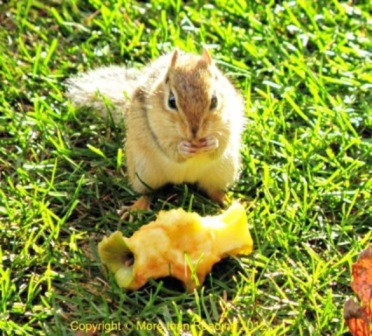
Guess what happens during Co-operative Show and Tell in Ms Squilley Squirrel’s Year One classroom at Bushland Primary School today.

Charlie Chipmunk brings a freshly-chewed apple core that he finds in the grass at the base of a red maple tree. Ms Squilley Squirrel doesn’t see anything interesting in a chewed up, old apple core. But it’s the most exciting thing that’s happened to Charlie Chipmunk this morning and he can’t wait to talk about it – and that’s all that matters.

Charlie Chipmunk and Doris Dove choose to share with each other. Often her students choose friends. Ms Squilley Squirrel doesn’t know why Charlie and Doris choose each other, they just go together. And that’s okay. Doris doesn’t bring anything – and that’s okay too – Doris talks about how she likes to sit on a telephone wire at sunrise and coo peacefully.

Black-eyed Susan and Black-eyed Sarah sway closer together, petal-to-petal, ready to talk and make black-eye contact. First thing this morning, Susan excitedly tells Ms Squilley Squirrel about a black and yellow bumble bee that visits her yesterday. And now, Susan can’t wait to tell Sarah about it .

Hetty House Finch and Chucky Chickadee get ready to turn to each other. Hetty is bursting to tweet about her close encounter with a red-tailed hawk and Chucky is excited about how he flew away fast and escaped the wrath of a Red-breasted Nuthatch at the bird feeder this morning.

Lucy, Larry and Lola Leaf make a group of three for their co-operative show and tell because, coincidentally, they all want to talk about their exciting falls to the ground.

Canada Geese waddle together and make a group of four. Glenda Goose asks Gloria Goose which way her family will fly as winter approaches. Gloria replies they’ll fly straight south. Gregory Goose chimes in that his family is going to Georgia then Gladys Goose adds that she is heading to Mexico with her cousins.

Woolly Bear, who rarely talks in front of the others, is happy to talk when the animals are in small groups. He talks to his friend Golden Woolly Bear about his favourite food, sedum leaves and to his surprise, he learns that Golden Woolly Bear loves sedum leaves too!

Some students finish co-operative show and tell. Charlie Chipmunk can’t wait to draw and write about the apple core he had shown Doris. He races to the flower pot and digs up his journal. Soon, everyone is drawing and writing in their journals. Ms Squilley Squirrel calls it Journal time.

But that’s another story…

An e-mail this morning, from a teacher friend in Australia, captures my attention. She alerts me to a request for help from another P-2 teacher.  It’s the beginning of term 4 and Yolanda, (not her real name) is running low on ideas and inspiration regarding topics for her children’s talking and sharing times.

I want to act immediately, get something out that could be useful right away – a talking/sharing strategy I call Co-operative Show and Tell –  and as you’ll see, it’s not the traditional ‘Show and Tell’. 

Teachers don’t have to search for topics when children provide a myriad of topics themselves. More interest, and more meaningful sharing, listening and writing for the children.

I decide to extract the Co-operative Show and Tell strategy (just two pages) from my book, Teaching Strategies for Literacy in the Early Years and share a free PDF download with Yolanda and interested others.

Here is your free download:  Enjoy!!

P.S.  I’ve also updated my website with the free download of Co-operative Show and Tell.

P.P.S.  Click here for more about Co-operative Show and Tell as a valuable pre-writing time. (An article I wrote for Practically Primary,  2010 and later wrote as a blog called ‘Please don’t ask me…’).

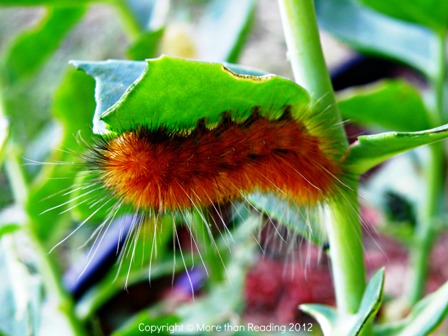
This is the woolly bear that eats the sedum that lives in the garden that lies at the side of the house.

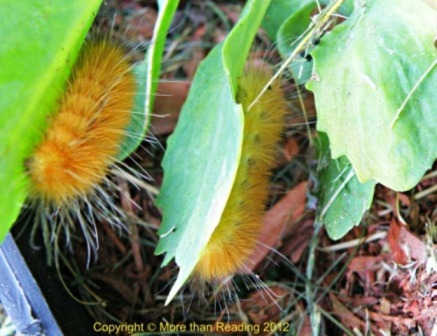
This is the golden woolly bear that eats the green sedum that lives in the small garden that lies at the north side of the house.

This is the bunch of woolly bears and golden woolly bears that feast on the green sedum leaves that live in the small, window garden that lies at the cool, north side of the house (How many caterpillars? How many nibbled leaves can you see?)

This is the jar for the golden and woolly bears that eat the green sedum leaves that live in the small, window garden at the cool, north side of  the house.

This is the  soft, golden cocoon that is spun by the golden woolly bear that is now in the glass jar with the silver-green sedum leaves that come from the small, window garden at the cool, north side of  the house.

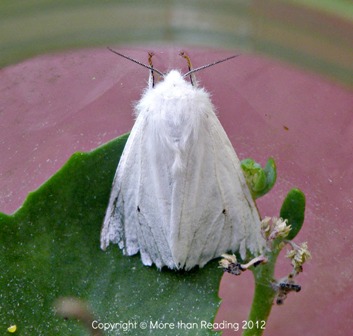
This is the back of the small, white moth that comes from the golden cocoon after its two weeks in the glass jar with the green sedum leaves that come from the small, window garden at the cool, north side of  the house.

This is the front of the small, white moth that comes from the fuzzy cocoon after its two weeks in the glass jar with the green sedum leaves that come from the small, window garden at the cool, north side of  the house.

And this is the sedum that lives in the garden that lies at the north side of the house – that the moth’s eggs may hatch in so that woolly bear caterpillars can devour the leaves once again…

With thanks to the writer of the the Nursery Rhyme and cumulative story, This is the House that Jack Built.


What are ten of your favourite picture books for your classroom or library? Thanks to @mandyrobek and @CathyMere we can share ten favourite picture books on Blogs and Twitter today: #PB10for10. Here are ten special books that I love to share with children – in no particular order.

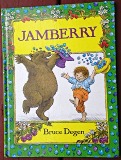
 Jamberry by Bruce Degen (1983) is a hugely enjoyable book with rollicking rhyme and rhythm – I can’t help but ‘sing-a-long’ to the words. Children pick up on the rhythmical language and join in. Colouful, clear illustrations and expressions of the characters add to the fun. A book to read and re-read!


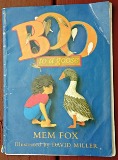
Boo to a Goose by Mem Fox (1996) is also rhythmical, giving children a sense of rhyming words – great for beginning readers. Bright, clear illustrations add clarity to the sentences and a repetitive refrain invites children to join in. The big print enables children to easily see the text and participate in shared reading.


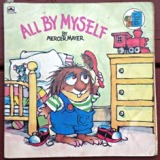
All by Myself by Mercer Mayer  (1983) is one of Mercer’s many delightful, kid-friendly books that are funny and easy for developing readers. The clear, expressive illlustrations enhance the simple language and messages. All by Myself is valuable for beginning readers with the repetitive sentence starter of ‘I can…’ and child-like actions. A funny book to also help children’s writing!


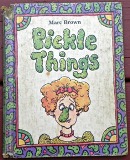
Pickle Things by Marc Brown (1980) is a funny rhyming book.  The bold pictures illustrate the crazy sentences as in: Pickle things you never make… like pickle pie and pickle cake. Pickle donuts, pickle flakes. Children laugh out loud at the absurdity of the pickle suggestions and uses. Big print and few words per page also help developing readers. A one-of-a-kind book!


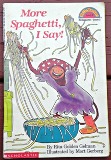
More Spaghetti, I Say by Rita Golden Gelman (1977) is loads of fun for children with its child-like antics and responses. The rhyme, rhythm and enlarged text make it a sought after book for developing readers. Clear, expressive illustrations add to the hilarity of the story. Laugh out loud!


Handa’s Surprise by Eileen Browne (1994) is a superbly illustrated storybook with bright colours, fruits and animals of hot Africa. The simple and thoughtful story in words is enhanced by clear illustrations that tell another story… which is indeed a surprise. A real gem!


little blue and little yellow by Leo Lionni was published in 1959, but notions of friendship, co-operation and tolerance are still relevant.  The message is clear – told in direct sentences and accompanying sparse ‘blobs’ of colour.  A delight!


A Fish out of Water by Helen Palmer (Suess Beginner Book, 1983) is a favourite with children because they identify with the boy’s actions that cause the problem –  starting small and getting bigger all the time. Children are enthralled by the unfolding catastrophes – in words and illustrations!


Mr Archimedes’ Bath by Pamela Allen (1980) is a funny story that makes children think, wonder and try to solve the water problem. It’s a good book to include in any unit of work or study on ‘Water’. The animals in the illustrations keep their skin/fur on but Mr Archimedes is naked, which adds to children’s guffawing and laughter. A literary book for ‘integration across the curriculum’.


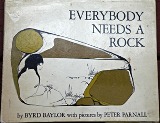
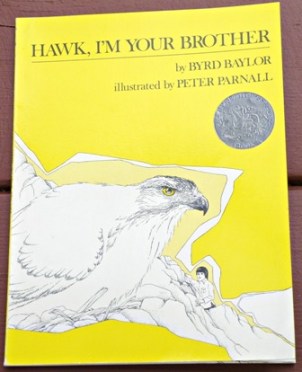
Everybody Needs a Rock by Byrd Baylor (1974) is a favourite of mine – although a bit long for some children. Baylor gives ten apt and often amusing rules for finding your own special rock. The poetic words are accompanied by Peter Parnall’s sparse, expressive illustrations that perfectly depict the rule. An absolute joy!

On reflection, I see that many of these books are ‘old’ favourites – but still exciting and memorable picture books to enjoy with young children. Maybe you can find some of them to enjoy too!

“When a pine needle falls in the forest;
the eagle hears it,
the deer sees it, and
the bear smells it.”
…an old First Nations saying.

“Look! Down the end of the road,” shouts our neighbour.
Straining our eyes and peering into the distance we see a smudge of brown against the grassy slope.

Suddenly a car noise. The deer turns sharply to take off back into the forest.
It’s hard to focus the camera.

A few minutes after the car passes, the deer reappears. Crosses the road towards the opposite green belt, stops.

A long way away. Three hundred metres at a guess. I steady the camera against the big, blue spruce at the front of the house. Try for another photo. Digital zoom. Focus.
Not perfect. But the best I can do. The deer moves off. Into the trees.
I walk down the road. Quietly. Slowly. Optimistically. Hoping the deer may stop to browse on willow leaves.
No luck. No deer. Maybe she saw me, smelled me, heard me.

Later that day, a neighbour asks if we saw a fawn running up the greenbelt next to our house and I wonder if the fawn belonged to the deer we saw earlier at the end of the road.

No. Missed it. I was inside folding laundry!

“Hey Honey. Grab your camera. Will’s got a bird at his front door.”

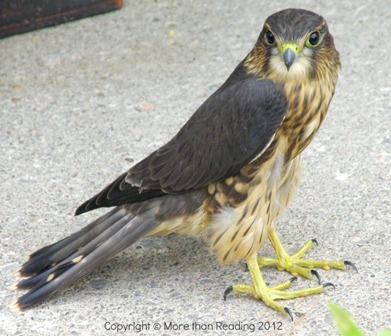
For the second time in four days. A photo opportunity. And a learning opportunity. Excitedly I cross the road and see a small hawk on the lawn.
Is his wing broken?

He struggles and flaps his wings trying to get away from the admiring humans. He runs towards the open garage but stops on nearby bags of soil –
a higher vantage point perhaps?

Note the strong, sharp talons!

From there, he walks to the patio, watching us all the time.
I see his sharp, hooked beak and his ‘fierce, free eyes’ – as Byrd Baylor (1976) describes Rudy Soto’s hawk in Hawk, I’m Your Brother.

I see a droopy left wing, stopping him from flying as a hawk is meant to fly: soaring, gliding, diving…

One last photo, then we leave him in peace…

I phone and leave a message at a wildlife centre to see what we should/could do with a young hawk with a possible broken wing.

An hour later the hawk goes from Will’s front yard. When he leaves and where he goes, we do not know. It’s up to Mother Nature now…

As for me…
I re-read and relish Byrd Baylor’s wonderful book, Hawk, I’m Your Brother.

I also aim for ‘just-in-time-learning’.

I look up ‘hawks’ in the index of A Guide to Field Identification, Birds of North America (1966) by Robbins, Bruun and Zim and flip through sixteen pages of vultures, hawks and falcons (all of whom are in Order Falconformes) and learn that they are ‘diurnal flesh eaters and most take live prey.’  In addition, they ‘all have a heavy, sharp, hooked bill, and toes with strong curved talons’ (p. 64). However, I am not sure which hawk this one is…

I Google. But there are many, many choices…

I’ll settle for ‘hawk’ for the time being!

Can you share your information about hawks?  

“Hey, Honey. Get your camera. Come out here. Quick!” my husband calls.

I grab my camera and race out the sliding doors onto the back deck. In the middle of the right hand side of the back lawn sits a snapping turtle – about a foot across the shell.

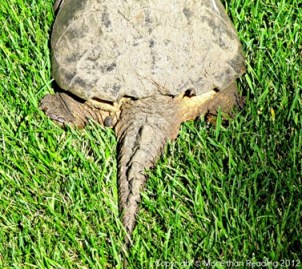
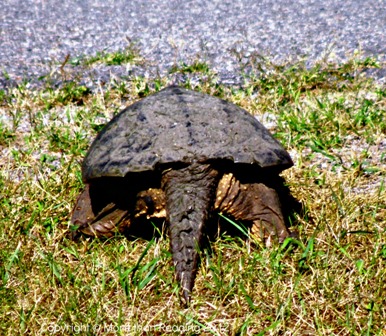
A rounded, grey head protrudes from her shell – not tucked within as I have seen with other turtles – and her triangular, spiked tail sticks out the back.

Old neck folds wrinkle and gather between her head and shell.

Four grey, scaly legs protrude from the shell and get lost in the grass – ready to be cut. In fact, Bill was cutting the grass when he saw her…

We look. From front, back and sides. Grey, muddy shell. Almost smooth. Unclear markings. Round head. Not pretty. Pre-historic. Zig-zag edge at the back of her shell, from which a ‘dinosaur-like’ scaled, tail protrudes.

She is plopped on the ground – and looks at us. Alert. Wary. Sand is in her right eye and she rubs her right front leg across her eye as if to clear it: “All the better to see you with, my dear!”

Why is this snapping turtle on our back lawn?

Where has she been?

Where is she going?

We assume she laid eggs (in the greenbelt woodland area behind? under our back cedar trees?) and is now returning to the lake 200-300 yards in front of us… in an easterly direction.

I stop taking photos and retreat to the back deck. Give her space.

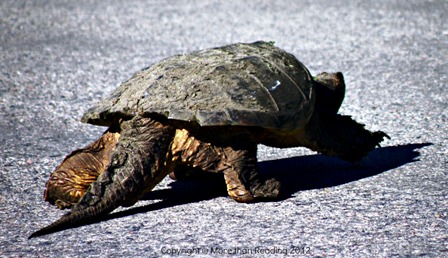
Soon, she rises slowly and walks. Lumbers really. In a straight line between our house and a neighbour’s house – no fences here. Makes it easy for her… slow and steady wins the race.

Seeing the snapping turtle heading for water reminds me of Lynley Dodds’ book (1985), The Smallest Turtle  when turtle babies hatch on the beach and hear the water calling: “To the sea! To the sea!” with illustrations of hatchlings racing, stumbling and scrambling over the hot, white sand to the cool, clear sea… racing to avoid being picked off by seagulls overhead.

I run to the front of the house and peek around the corner. She’s lumbering with a steady gait, rhythmical, almost swinging. Not ungainly. Each time she sees me, she plops and stops.

I hide. She continues walking on the grass. Two neighbours come to look. She plops again. Head moving. Watching us. Each time we move out of sight, she walks – but the minute she sees one of us, she plops!

How wide is her peripheral vision?

Finally, we let her go. To get on with her task. Her walk. I hope she accomplishes her mission and reaches her destination…  but first, there’s a road to cross.

From behind a low juniper tree I watch her traverse the ditch by the side of the road and go onto the road.  Steadily, rhythmically and safely she strides across the bitumen, with speed it seems – no cars come along at the time. Maybe the hard surface is easier to walk on than soft grass and ground?

She goes up the ditch on the other side of the road, onto a neighbour’s grass. I watch her until she’s out of sight; swallowed by shadows of distant trees. Three more lawns to go, a small road, woods and then the lake…

I hope she makes it!

No wonder these signs are on highways around here.

This is the first snapping turtle I have ever seen, so I want to find out about it. ‘Just in time learning’ I call it – learning when one needs it. When information is meaningful and relevant.

How much learning in your classroom is ‘just in time learning’?

When children bring tadpoles, caterpillars, a green tree frog, a butterfly, a bird’s nest or almost anything from nature, we take the time to look, talk and share – both knowledge and experiences. Sometimes, the shared item grows into a ‘mini-unit’ or a ‘short study’ with drawings, photos, sentences, vocabulary, sounds, word work, writing and reading. And, there’s always research… books, charts and internet. ‘Strike while the iron’s hot’. ‘Just in time learning’ occurs for children and adults. We learn interesting things together.

Later, I find out that a snapping turtle’s plastron is ‘yellowish, small and cross-shaped: legs and underbelly are not well protected’ (http://torontozoo.ca).
But I had to look up the word, plastron: the under portion of the shell of a turtle or tortoise that is made up of several, often hinged, bony plates joined to the carapace by bridges located between the animal’s legs (Encarta Dictionary).

Learn more about snapping turtles: http://torontozoo.ca/AdoptAPond/turtles.asp

Tell me about a turtle you have seen.