Sharing Early Literacy Learning Journeys

Archive for the ‘Writing’ Category

Dawn fog lifts by the lake to reveal an amazing sight

It’s mild and foggy as I head to the lake with camera in one hand and coffee in the other. The fog lifts, leaving a clear, sunny sky. Rounding the bend that leads to the lake an  amazing sight greets me: two large gaggles of geese are swimming on the lake in the distance. They are aware of me and start to swim away – but as they do, the gaggles come together, joining forces as it were, into one massive group – except they are not milling in a group, but stringing out in a long, long line.

Gaggle of geese in a line

Quickly I head behind the trees out of view of the geese. I race to the end of the lake for a closer look – and maybe some photos, despite their distance from shore.

I wonder why a group of five geese separates from the main string of geese. Are they the leaders? Are they on guard?
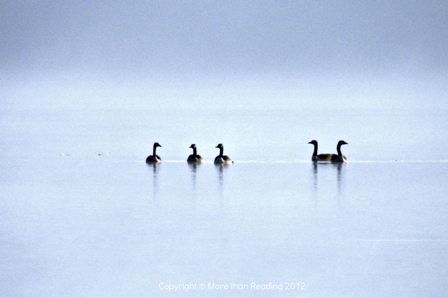
Five geese separate from the main group

The remaining group is large and the line is long. Too many geese to count from this far away. I watch and snap, snap, snap, moving along the strung out line of Canadian Geese. At the same time, the geese are slowly moving away.
Slowly, silently swimming, getting smaller and smaller. If they are aware of me, they are not afraid.

Suddenly, several geese honk in warning. I hear a splash in the water to my left – and wonder quickly if it’s a fish, a duck or an otter. To my disappoinment it’s a dog: a large, cream, labrador. He swims and cleans himself several times and then dog and master walk past. Meanwhile, the geese move further and further from shore… and photos fail to focus.

I turn and walk away, still smiling at my luck in seeing such a sight. I follow a narrow trail in the woods beside the lake – and I’m struck by another sight! This time, massive, dewy cobwebs sparkling in the sun. I stop. Sigh. And snap!
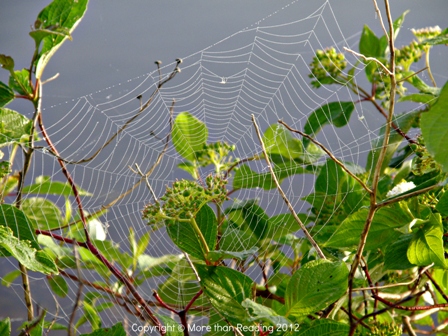
One of the many wonderful webs in the woods

And another web to gaze upon

The morethanreading blog is changing with my leave from full time Year One teaching. Like a child, I’m living in the moment – experiencing travelling and new environments. Interestingly, I also realise how much I am learning in the same way that my Year Ones learned – through Language Experience activities…

  • Participate and enjoy the experience
  • Talk about it, think about it
  • Take photos/or draw
  • Write and read about the experience/activity
  • Share
  • Read, research and make notes
  • Make photo stories
  • Share

On my way back for breakfast, two squirrels have breakfast. What a way to start the day!
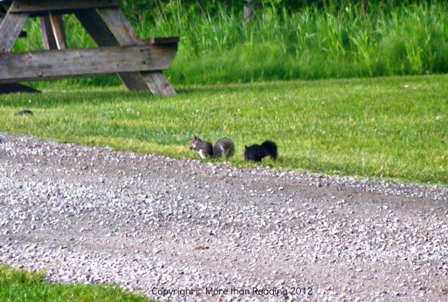
I didn’t know that black squirrels and grey squirrels met for breakfast!

And bounding up the hill from the lake I laugh to see an ‘h’ resting on the road. Maybe I can’t get away from school and children after all!
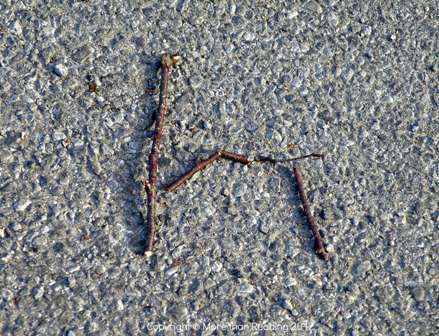
I couldn’t miss the ‘h’ on the road

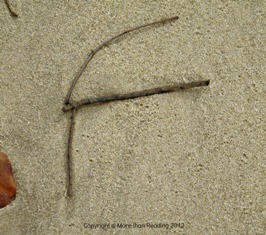
What was the highlight of your day today?

Alphabet Letters in Nature

Creating a nature photo story An April Alphabet got me thinking. Since being on leave, I’ve had the luxury of more time to explore my natural surrounds–to walk and wander on nearby beaches, fields, forests and trails–and to become more aware of letters (and numbers) in nature. I’m reminded of the times children brought in a curled up witchetty grub that looked like an ‘o’, a caterpillar lying straight on a leaf that looked like an ‘l’ and a stick in the shape of a ‘t’.

Finding letters in nature is a fun way for children to learn the look, names and sounds of letters.

Questions arise…
Some letters seem to appear more often than others, such as c, j, l, o, t, v and y. And I wonder why?

What are some of the letters made of?

Sticks:

The stick ‘r’ was found on the beach

An ‘f’ was found on the beach sand, too

This ‘E’ was a special find on the beach

Leaves:

A gum leaf ‘c’ became a common find on treed paths and walkways

Plants and plant pieces:

‘l’ or ‘i’ was a frequent find after high tide

A ‘v’ spread onto the beach sand

Trees:

‘Y’ is easy to find in trees

And now for something different: worms

After rain, worms wriggle onto the driveway

What letters or numbers have you seen in your natural environment?

‘S’ for Saturday and Squirrel

Saturday morning

In the backyard,
Looking for signs of spring.
Buds, leaves,
Dandelions, in the grass.
Suddenly…
A grey squirrel, in a tree,
Near the house.

Quiet. We look at him. He looks at us. He nibbles. On a bud… a seed… a pine cone? Hard to distinguish.

Whirr of the camera. He takes off. Down the tree. Over the grass. Scampering. Across the greenbelt. Running. To a big tree. Up, up, up. Way up. Climbing. Leaping. Branch to branch.  Stops. Nibbles again.

Photos. Thank goodness for digital photos that are easily deleted!
But, some turned out…

This slideshow requires JavaScript.

Do you know this poem?

The Squirrel

Whisky, frisky,
Hippity hop,
Up he goes
To the tree top!

Whirly, twirly,
Round and round,
Down he scampers,
To the ground.

Furly, curly
What a tail!
Tall as a feather
Broad as a sail!

Where’s his supper?
In the shell,
Snappity, crackity,
Out it fell!

Author unknown

Looking for information about squirrels?

Here’s a website about Squirrels simple, fun–and easy for children:  http://www.ofnc.ca/fletcher/our_animals/squirrels/grey-squirrels_e.php

The Power of Words

In the last two blogs we talked about ‘words that work’. Then, a friend sent me this video about the power of words – and I wanted to share it. At well under 2 minutes, it’s nice and short.

You may need to turn up the volume to hear the words better…

Enjoy!

Back to school…for the last term

Holidays have a curious habit of flying by. It seems like only yesterday I was writing about loading my bags on the early morning shuttle to the airport.
In the blink of an eye, it’s back to school – October 3rd, the first day of the last term. Reality hits home. There’s an initial reluctance in starting work. I push aside fleeting thoughts of just one more week!  There’s no gradual transition, no time to ease in gently. The first child arrives and I’m into it.

Monday. Professional Development for teachers. We collaborate on aspects of reading, spelling and explicit teaching.

Tuesday. A significant milestone for the children, their parents and me – Year One students return for their last term. In just ten weeks they will finish and head into Christmas holidays, then Year Two in February,  2012.

8:15 AM. The first children trickle in. They come into my room early—it’s an important part of our day when children and parents have opportunities to interact and share informally—I call it a ‘staggered start’.  It’s even more important the first day of term to make sure the children have extra time to talk and share about events and experiences of their past two weeks. The children’s energy and enthusiasm is contagious, it renews me. This is the best way I know to make an effective transition from holiday to work mode. Cobwebs clear, gears click back into motion, the passion returns.

Bounding up the stairs, Terry calls from the doorway, “Good morning Mrs Swan.” He walks over and stops before me… as if to give me a hug. “Good morning Terry.  Hey, you look terrific with that new haircut. How were your holidays?” Words gush out excitedly as he recounts his stay in a nearby resort.

Striding in, Donny greets me with his big, wide grin. I compliment him on his sporty new haircut that suits him so well. He seems taller. Has he grown in the two weeks away?

Quietly entering the room, Zack whispers, “Good morning.” I comment on his new, bright-white and red running shoes – adding that I got new running shoes on the holidays too.

More children and parents come in and mill around, asking about holidays and chatting happily with all and sundry. It’s wonderful to see everyone again.

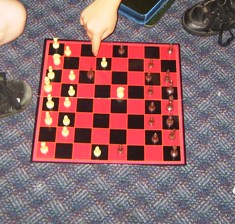
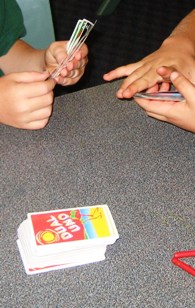
Several boys come in with new games and proceed to show their friends how to play Chess and Uno.

Rex teaches Clay to play chess

Henry teaches Terry to play Uno

Two crickets arrive. In a plastic container carried by Kerrie.

A shiny, colourful leaf appears. Misty found it on her walk to school. Adults and children admire nature’s contributions.

Misty brings in a shiny, colourful leaf

...and I bring in freshly-washed covers for the reading cushions!

What a thrill – children voluntarily writing out of school…

Annie walks in smiling, hands me two pages of writing on pretty, blue paper and says, “Good morning Mrs Swan. Yesterday at my nana’s, I wrote my journal.”

Esther walks in quietly, smiling and firmly gripping an exercise book in her hands. “This is my journal about my holidays,” she says happily.

Later, Annie and Esther read their journal entries to the class: family trips, outings and holidays. Other children chime in and discuss their holiday activities – camping, fishing, ice-skating, movies, swimming in resort and home pools, riding bikes, building sandcastles and going to Grandma’s.

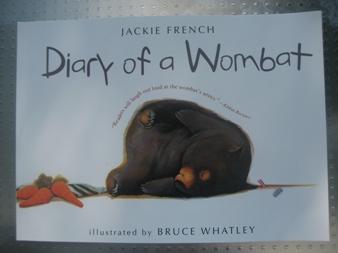
As Esther reads her journal, Molly says, “It’s like the Diary of a Wombat, with the short sentences.”

Molly thinks Esther's journal sounds like the writing in 'Diary of a Wombat'.

Key words on the board. During our pre-writing talking time of  co-operative show and tell, some children request key words to be written on the board – new words they may need in their writing: camping, movies, water-slide, sandcastle, Granite Gorge, Port Douglas Resort, Kurrimine Beach, Cairns Central Shopping Centre, Cairns Esplanade Lagoon

Visualising. Before moving to their writing I ask the children to visualise what they are going to write about and to put possible sentences in their heads. I remind them to think about adjectives they could use to describe objects, places or events and words to tell how they feel. Finally, I add Natalie Goldberg’s advice: Be specific! Not car, but cadillac. Not tree, but sycamore.   ‘It is much better to say “the geranium in the window” than “the flower in the window.” “Geranium”  – that one word gives us a much more specific picture… It immediately gives us the scene by the window—red petals, green circular leaves, all straining toward sunlight’ (Goldberg, 1986, p 77).

A few weeks later…
It’s great to be back. Children help each other with ideas, words, spelling. There’s quality writing from all. One of the children writes a seven page story in her journal. I realise how far their writing has come since starting the year in February and I can’t wait to see how far they can go by the end of the year.

Up, up and away… for holidays

It’s 3am, dark as I leave for the airport. Suitcase wheels on concrete break the silence. Waves on the beach across the road, barely murmur. I’m off:  A journey of a thousand miles must begin with a single step (Lao Tzu).

School holidays. Visit family in USA. Strengthen ties. Broaden horizons. Expand minds.  Break routines. See, smell, hear other places.  Taste other foods. See with different eyes: Who lives sees much. Who travels sees more.

On three planes. Read (Talking about Jane Austen in Baghad, A House Somewhere). Write (my journal). Complete crosswords (without looking at the answers – mostly).  Look out the window. Clouds above and sea below. The coastline of San Francisco looms ahead and we dip low over the water to come into land (tomato bisque in sourdough soup bowl).

Another plane. Smaller this time. Big sky. Clear views. Brown, orange and beige land lie below. Blue rivers slither across the dryness. Patchwork quilts of crops appear. Sworls of green. Very different from the wheatfarms of the mallee all those years ago. “The world is a book and those who do not travel read only one page,”  said St Augustine.

Arrive. Open arms and wide smiles. Hugs all around. In the car. Thankfully, not driving. On the other side of the road. To the house. More welcomes. Look around. What’s the same? What’s different? “One’s destination is never a place, but a new way of seeing things,” said Henry Miller. No school concerns here. Travelling stimulates and refreshes me as I drink in myriad experiences.

A road trip

A short stay

A foothills trek

Keep going...

On the way, see, smell and taste different foods.
Idaho trout and ratatouille. Blueberry muffins. Raspberry muffins. Zucchini sticks. Sri Lankan chicken. Alaskan halibut. Huckleberry pancakes. Moussaka. Huge sandwiches from The Blue Moose Cafe with crystal clear water in mason jars. And lastly, strong, aromatic filtered coffee!

Travel and change of place impart new vigor to the mind (Seneca). That’s true for me. I’m stimulated, enthused and refreshed by travelling. When parents say they are taking their child out of school for a trip I send them off with a personalised ‘Travel Book’ for the child to record experiences (drawings, writing, tickets, pamphlets) and say, “Enjoy… I can’t give Tim or Tam those experiences within these four walls!”

Samuel Johnson explains, “The use of travelling is to regulate imagination by reality, and instead of thinking how things may be, to see them as they are.”

What do you do to refresh and invigorate at the end of a week, end of a term, at the end of a year? 

We’re going to the zoo, zoo, zoo…

 Harry is the first to arrive. Then Jack and Rowena. Jack’s mum says he’s been awake since 5:30. “We can’t be late,” he says. ” The bus leaves at 9.”  More excited Year 1s come to the classroom as they arrive at school. They wear school uniforms, including closed shoes and hats.  Lunches and drinks in plastic bags are placed in the plastic tub according to the adult who will care for that group of five children on our class trip today. We are going to the Tropical Zoo.

This is part of our unit of work on Australian Animals. Individual ‘studies’ of a self-selected animal and a ‘What am I?’ writing task are well underway. Paintings of animal habitats are awaiting animals. Seeing live animals at the zoo is special. 

And… off we go on the bus! Past houses, shops and shopping centres. Past creeks, cane fields and paddocks of playful horses. We go over bridges, through roundabouts and on highways until we reach the zoo.

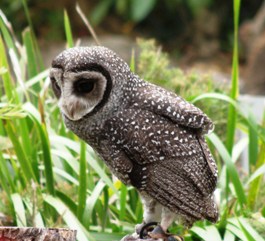
We leave the containers of lunches at the large undercover picnic area then head up the hill to the Bird Show.  A young zoo worker provides an informative and humorous commentary as we see the birds: a quiet lesser sooty owl, a beautiful Major Mitchell cockatoo, a black and red cockatoo, a sulpher-crested cockatoo, a cheeky magpie that puts a tissue paper into a bin, a barking owl and a serious white sea eagle – spectacular!
PS How long did it take a zoo worker to train the magpie to put paper into the bin? 
3 days? 3 months? 1 day? 50 minutes? 20 minutes? 1 hour? 4 hours?

A fascinating lesser sooty owl

The beautiful Major Mitchell cockatoo

Next, we go to the kangaroos and then to the crocodiles.  Unexpectedly, we see zoo workers moving a large crocodile. The crocodile’s snout is bound with rope and about ten strong handlers hold him. It looks like hard work… We move on to see crocodiles warming up in the sun and an occasional crocodile opening its mouth to cool down. Other crocs keep cool under water.

Is the crocodile opening its mouth to keep cool?

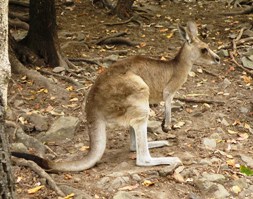
A kangaroo is nicely camouflaged

After lunch, the adults and small groups of children walk  through the zoo. We see three striped lemurs, a red panda, a well-fed dingo, a resting wombat, a pacing cassowary, numerous sleeping koalas, several long, sleek snakes, green tree frogs, American alligators, eastern water dragons, a blue-tongue lizard, a glorious iguana and dozens of colourul birds. We read the notices giving us information about the animals. We all learn lots!

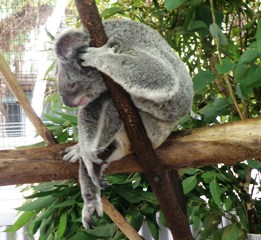
Koalas can sleep 75% of the day

An eastern water dragon heads towards water

It is a wonderful walk… and slowly we head back to the bus for the return to school.
Tomorrow the children will talk, draw and write about the trip as we re-live the real-life experience.

What excursions does your class take out of school?

Building bushland and crocodile habitats in a Year 1 classroom

A branch stands in a bucket and sticks, leaves and gumnuts litter the floor in the ‘bushland’ area of the classroom. A koala, kookaburra, ring-tailed possum and sugar glider sit and hang in the branches. Kangaroos are on the ‘ground’ along with assorted snakes, ants and insects. By the windows, a green tree frog sits on the rafters looking down at the hanging vines, sand, ‘mangroves’ and crocodiles who live in the ‘crocodile habitat’ below. The geographical areas and animals reflect our unit of work this term: Australian Animals.

A possum hangs from a branch

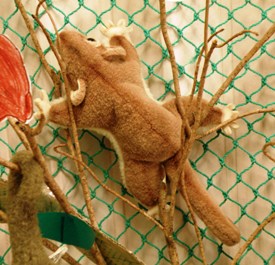
A glider hangs hangs on for dear life

Kangaroos look for grass amongst the leaves

The green tree frog looks for a damp area

Crocodile habitat – with turtles and frogs in the mix.

The children choose one animal to study. They write a ‘What am I?’ for a class big book – and they learn interesting facts about that  animal. For example, did you know that:

  • really hungry crocodiles will eat bats?
  • most kangaroos can only move both back legs together and not one at a time?
  • green ants can carry up to 20 times their weight?
  • wombats have backward-facing pouches so dirt does not get over the young as wombats dig?
  • koalas sleep about 75% of their time?
This koala is awake!
How are your units of work refelcted in your classroom?