Sharing Early Literacy Learning Journeys

Archive for the ‘Language Experience’ Category

‘S’ for Saturday and Squirrel

Saturday morning

In the backyard,
Looking for signs of spring.
Buds, leaves,
Dandelions, in the grass.
Suddenly…
A grey squirrel, in a tree,
Near the house.

Quiet. We look at him. He looks at us. He nibbles. On a bud… a seed… a pine cone? Hard to distinguish.

Whirr of the camera. He takes off. Down the tree. Over the grass. Scampering. Across the greenbelt. Running. To a big tree. Up, up, up. Way up. Climbing. Leaping. Branch to branch.  Stops. Nibbles again.

Photos. Thank goodness for digital photos that are easily deleted!
But, some turned out…

This slideshow requires JavaScript.

Do you know this poem?

The Squirrel

Whisky, frisky,
Hippity hop,
Up he goes
To the tree top!

Whirly, twirly,
Round and round,
Down he scampers,
To the ground.

Furly, curly
What a tail!
Tall as a feather
Broad as a sail!

Where’s his supper?
In the shell,
Snappity, crackity,
Out it fell!

Author unknown

Looking for information about squirrels?

Here’s a website about Squirrels simple, fun–and easy for children:  http://www.ofnc.ca/fletcher/our_animals/squirrels/grey-squirrels_e.php

E is for erosion – and earth day

Today is Earth Day. Let’s look at mother nature at work. Late March. Early April.
Sunday: torrential rains, high tides and wild waves.
Monday: torrential rains, high tides and wild waves.
What happened at the beach?

Torrential rains for several days

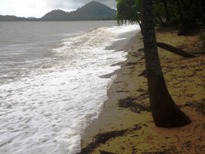
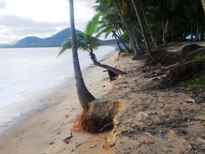
In the morning, high tides and pounding waves hit the foreshore. Note the location of the large palm trunk in the front and the heavily slanted, small palm trunk behind.

Tides and waves create a 'new' foreshore.

Tuesday morning. Destruction revealed. Beach sand washed away.

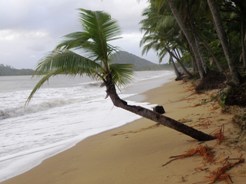
Now look at the front palm trunk and the slanted palm trunk!

One wonders:
How much beach sand has gone? How long will the teetering palm trees last?
Is this ‘natural’ erosion? Has it been helped and/or hastened by man?

And then…
More rain and high tides in April.

By mid April, more sand has washed away.

What will tomorrow bring?

Hooray! A happy ending. The sands come back…

Nature's way: beach sand comes back...

Time for a walk to learn the names of unknown trees and flowers.
Happy earth day, everyone. How will you celebrate?

Python Dines on Christmas Wallaby

New Year’s Eve. Early morning. A brisk walk.  Around the resort. Stop occasionally. Take photos. Mainly flowers. Bright red. Pink. Yellow. Pass walkers. Chat to workers. A couple asks, “Do you want to see a python? A big python? A 4 metre python that ate a small wallaby on Christmas Day?”

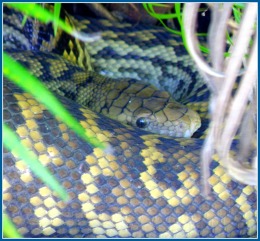
Walk. Past a small, Chinese shrine. Up a short, steep hill. Almost stumble on stones. Turn right. Cross mown, green grass. See golden cane palm. Eyes search tangle of dead fronds.  Adjust from sun to shade. Careful. Not too close! Through the camera lens from here. A curled up python. A patterned python. Camouflaged. One part of his body MUCH wider than the rest. The wallaby?

The curled up python was resting and digesting

The couple watched the python swallow the small wallaby on Christmas Day, “…being careful not to disturb the snake as he ate because surprise or stress can cause the prey’s bones to break and maybe rupture the snake’s skin or stomach,” added another local.

Six days later. Snake still resting and digesting.
Body still very wide in one part.

Left wondering. How did the python catch the wallaby?  Did it silently slither over the grass, drop down from an over-hanging branch or coil and spring at the wallaby?

That's one stretched tummy!

The python looked docile, but he kept a watchful eye on us...

I couldn’t wait to share this morning’s rich experience with you, partly because it’s a fascinating glimpse into nature, but more importantly, it took me back to when our children were 5 or 6 years old and how, whilst walking—on a beach, in a rainforest, along a country road–we forged lasting family memories and made some of our most interesting and unexpected discoveries: a Leatherback turtle laying eggs in the sand; a brilliant blue Ulysses butterfly; a sleek red-fox searching for his supper. But most significantly, we spent time together—laughing, sharing, discovering, talking.

We don’t have to live near a beach or rainforest—it can be a sidewalk, a park, a backyard. It doesn’t matter where we are; we can always learn from our children—they are naturally and insatiably curious, and often notice things adults miss. When we respond to our children’s comments and questions, something special happens—we learn together.

I love the following story. John Medina paints a beautiful picture of the magic that can happen when a parent walks with a child:

 “My two year old son Noah and I were walking down the street on our way to preschool when he suddenly noticed a shiny pebble embedded in the concrete. Stopping midstride, the little guy considered it for a second, found it thoroughly delightful, and let out a laugh. He spied a small plant and an inch farther, a weed valiantly struggling through a crack in the asphalt. He touched it gently, then laughed again. Noah noticed beyond it a platoon of ants marching in single file, which he bent to examine closely. They were carrying a dead bug, and Noah clapped his hands in wonder. There were dust particles, a rusted screw, a shiny spot of oil. Fifteen minutes had passed, and we had gone only 20 feet. I tried to get him to move along, having the audacity to act like an adult with a schedule. He was having none of it. And I stopped, watching my little teacher, wondering how long it had been since I had taken 15 minutes to walk 20 feet”.

(John Medina, 2008, Brain Rules, p. 278-279, Seattle, WA: Pear Press).

In a Nutshell:
Going for a walk is one of the easiest ways to spend precious time with your child. And, above all, when you spend time with your children, you send them the most important message of all—that you love them.

Comments:
I’d love to hear your story about a walk you took with your child—something beautiful, something scary, something you learned, something you’ll never forget…

Lets’ inspire parents to walk with a child.

Back to school…for the last term

Holidays have a curious habit of flying by. It seems like only yesterday I was writing about loading my bags on the early morning shuttle to the airport.
In the blink of an eye, it’s back to school – October 3rd, the first day of the last term. Reality hits home. There’s an initial reluctance in starting work. I push aside fleeting thoughts of just one more week!  There’s no gradual transition, no time to ease in gently. The first child arrives and I’m into it.

Monday. Professional Development for teachers. We collaborate on aspects of reading, spelling and explicit teaching.

Tuesday. A significant milestone for the children, their parents and me – Year One students return for their last term. In just ten weeks they will finish and head into Christmas holidays, then Year Two in February,  2012.

8:15 AM. The first children trickle in. They come into my room early—it’s an important part of our day when children and parents have opportunities to interact and share informally—I call it a ‘staggered start’.  It’s even more important the first day of term to make sure the children have extra time to talk and share about events and experiences of their past two weeks. The children’s energy and enthusiasm is contagious, it renews me. This is the best way I know to make an effective transition from holiday to work mode. Cobwebs clear, gears click back into motion, the passion returns.

Bounding up the stairs, Terry calls from the doorway, “Good morning Mrs Swan.” He walks over and stops before me… as if to give me a hug. “Good morning Terry.  Hey, you look terrific with that new haircut. How were your holidays?” Words gush out excitedly as he recounts his stay in a nearby resort.

Striding in, Donny greets me with his big, wide grin. I compliment him on his sporty new haircut that suits him so well. He seems taller. Has he grown in the two weeks away?

Quietly entering the room, Zack whispers, “Good morning.” I comment on his new, bright-white and red running shoes – adding that I got new running shoes on the holidays too.

More children and parents come in and mill around, asking about holidays and chatting happily with all and sundry. It’s wonderful to see everyone again.

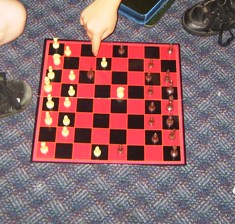
Several boys come in with new games and proceed to show their friends how to play Chess and Uno.

Rex teaches Clay to play chess
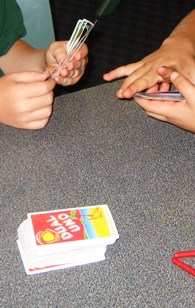
Henry teaches Terry to play Uno

Two crickets arrive. In a plastic container carried by Kerrie.

A shiny, colourful leaf appears. Misty found it on her walk to school. Adults and children admire nature’s contributions.
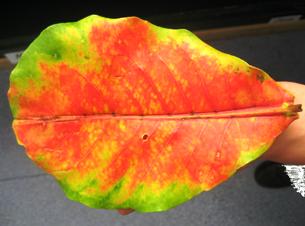
Misty brings in a shiny, colourful leaf

...and I bring in freshly-washed covers for the reading cushions!

What a thrill – children voluntarily writing out of school…

Annie walks in smiling, hands me two pages of writing on pretty, blue paper and says, “Good morning Mrs Swan. Yesterday at my nana’s, I wrote my journal.”

Esther walks in quietly, smiling and firmly gripping an exercise book in her hands. “This is my journal about my holidays,” she says happily.

Later, Annie and Esther read their journal entries to the class: family trips, outings and holidays. Other children chime in and discuss their holiday activities – camping, fishing, ice-skating, movies, swimming in resort and home pools, riding bikes, building sandcastles and going to Grandma’s.

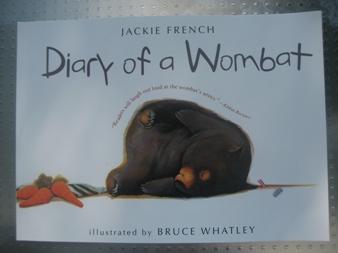
As Esther reads her journal, Molly says, “It’s like the Diary of a Wombat, with the short sentences.”

Molly thinks Esther's journal sounds like the writing in 'Diary of a Wombat'.

Key words on the board. During our pre-writing talking time of  co-operative show and tell, some children request key words to be written on the board – new words they may need in their writing: camping, movies, water-slide, sandcastle, Granite Gorge, Port Douglas Resort, Kurrimine Beach, Cairns Central Shopping Centre, Cairns Esplanade Lagoon

Visualising. Before moving to their writing I ask the children to visualise what they are going to write about and to put possible sentences in their heads. I remind them to think about adjectives they could use to describe objects, places or events and words to tell how they feel. Finally, I add Natalie Goldberg’s advice: Be specific! Not car, but cadillac. Not tree, but sycamore.   ‘It is much better to say “the geranium in the window” than “the flower in the window.” “Geranium”  – that one word gives us a much more specific picture… It immediately gives us the scene by the window—red petals, green circular leaves, all straining toward sunlight’ (Goldberg, 1986, p 77).

A few weeks later…
It’s great to be back. Children help each other with ideas, words, spelling. There’s quality writing from all. One of the children writes a seven page story in her journal. I realise how far their writing has come since starting the year in February and I can’t wait to see how far they can go by the end of the year.

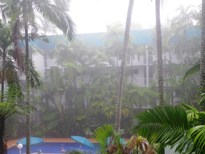
Up, up and away… for holidays

It’s 3am, dark as I leave for the airport. Suitcase wheels on concrete break the silence. Waves on the beach across the road, barely murmur. I’m off:  A journey of a thousand miles must begin with a single step (Lao Tzu).

School holidays. Visit family in USA. Strengthen ties. Broaden horizons. Expand minds.  Break routines. See, smell, hear other places.  Taste other foods. See with different eyes: Who lives sees much. Who travels sees more.

On three planes. Read (Talking about Jane Austen in Baghad, A House Somewhere). Write (my journal). Complete crosswords (without looking at the answers – mostly).  Look out the window. Clouds above and sea below. The coastline of San Francisco looms ahead and we dip low over the water to come into land (tomato bisque in sourdough soup bowl).

Another plane. Smaller this time. Big sky. Clear views. Brown, orange and beige land lie below. Blue rivers slither across the dryness. Patchwork quilts of crops appear. Sworls of green. Very different from the wheatfarms of the mallee all those years ago. “The world is a book and those who do not travel read only one page,”  said St Augustine.

Arrive. Open arms and wide smiles. Hugs all around. In the car. Thankfully, not driving. On the other side of the road. To the house. More welcomes. Look around. What’s the same? What’s different? “One’s destination is never a place, but a new way of seeing things,” said Henry Miller. No school concerns here. Travelling stimulates and refreshes me as I drink in myriad experiences.


A road trip

A short stay

A foothills trek

Keep going...

On the way, see, smell and taste different foods.
Idaho trout and ratatouille. Blueberry muffins. Raspberry muffins. Zucchini sticks. Sri Lankan chicken. Alaskan halibut. Huckleberry pancakes. Moussaka. Huge sandwiches from The Blue Moose Cafe with crystal clear water in mason jars. And lastly, strong, aromatic filtered coffee!

Travel and change of place impart new vigor to the mind (Seneca). That’s true for me. I’m stimulated, enthused and refreshed by travelling. When parents say they are taking their child out of school for a trip I send them off with a personalised ‘Travel Book’ for the child to record experiences (drawings, writing, tickets, pamphlets) and say, “Enjoy… I can’t give Tim or Tam those experiences within these four walls!”

Samuel Johnson explains, “The use of travelling is to regulate imagination by reality, and instead of thinking how things may be, to see them as they are.”

What do you do to refresh and invigorate at the end of a week, end of a term, at the end of a year? 

We’re going to the zoo, zoo, zoo…

 Harry is the first to arrive. Then Jack and Rowena. Jack’s mum says he’s been awake since 5:30. “We can’t be late,” he says. ” The bus leaves at 9.”  More excited Year 1s come to the classroom as they arrive at school. They wear school uniforms, including closed shoes and hats.  Lunches and drinks in plastic bags are placed in the plastic tub according to the adult who will care for that group of five children on our class trip today. We are going to the Tropical Zoo.

This is part of our unit of work on Australian Animals. Individual ‘studies’ of a self-selected animal and a ‘What am I?’ writing task are well underway. Paintings of animal habitats are awaiting animals. Seeing live animals at the zoo is special. 

And… off we go on the bus! Past houses, shops and shopping centres. Past creeks, cane fields and paddocks of playful horses. We go over bridges, through roundabouts and on highways until we reach the zoo.

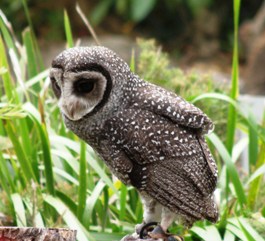
We leave the containers of lunches at the large undercover picnic area then head up the hill to the Bird Show.  A young zoo worker provides an informative and humorous commentary as we see the birds: a quiet lesser sooty owl, a beautiful Major Mitchell cockatoo, a black and red cockatoo, a sulpher-crested cockatoo, a cheeky magpie that puts a tissue paper into a bin, a barking owl and a serious white sea eagle – spectacular!
PS How long did it take a zoo worker to train the magpie to put paper into the bin? 
3 days? 3 months? 1 day? 50 minutes? 20 minutes? 1 hour? 4 hours?

A fascinating lesser sooty owl

The beautiful Major Mitchell cockatoo

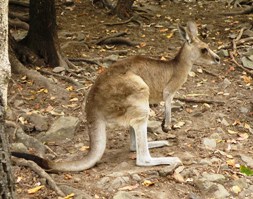
Next, we go to the kangaroos and then to the crocodiles.  Unexpectedly, we see zoo workers moving a large crocodile. The crocodile’s snout is bound with rope and about ten strong handlers hold him. It looks like hard work… We move on to see crocodiles warming up in the sun and an occasional crocodile opening its mouth to cool down. Other crocs keep cool under water.

Is the crocodile opening its mouth to keep cool?

A kangaroo is nicely camouflaged

After lunch, the adults and small groups of children walk  through the zoo. We see three striped lemurs, a red panda, a well-fed dingo, a resting wombat, a pacing cassowary, numerous sleeping koalas, several long, sleek snakes, green tree frogs, American alligators, eastern water dragons, a blue-tongue lizard, a glorious iguana and dozens of colourul birds. We read the notices giving us information about the animals. We all learn lots!

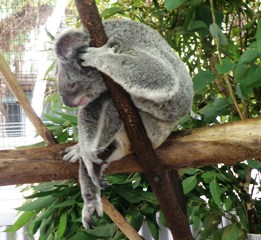
Koalas can sleep 75% of the day

An eastern water dragon heads towards water

It is a wonderful walk… and slowly we head back to the bus for the return to school.
Tomorrow the children will talk, draw and write about the trip as we re-live the real-life experience.

What excursions does your class take out of school?

Book Week with a Book Parade

Last week in Australia, we celebrated Book Week. We read short-listed books and winning books from the Younger Readers and Early Childhood Books Categories. I know how we early years teachers (and parents) are always looking for good books for our children, so in this blog you’ll find photos and my descriptions of 3 books that my Year Ones particularly enjoyed. And for those of you who enjoy quizzes, there’s a skill testing question for you in the caption under a child’s drawing in the Book Parade section. Enjoy!

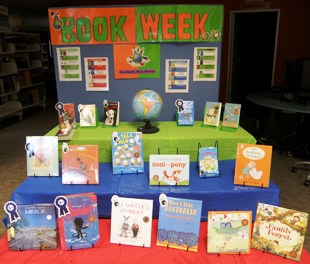
Book Week Books displayed in the Library

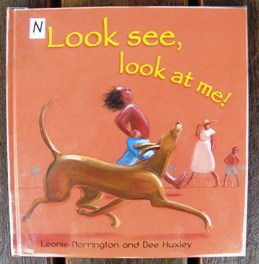
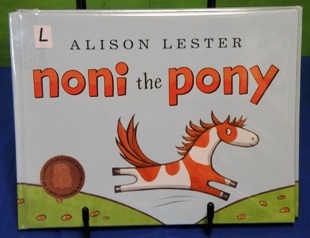
My class especially loved Look see, look at me, The Tall Man and Twelve Babies and Noni the pony.

Perfect for toddlers – and early readers!

Look see, look at me! is perfect as a read aloud for toddlers  – and ideal for early readers. I like to have any number of  ‘easy to read’ books in my Yr 1 classroom at the start of the year because they provide reading materials for beginning readers – without being ‘levelled books’.

'The Tall Man and the Twelve Babies'

The Tall Man and the Twelve Babies was appealing and funny. The children loved how the babies were all called Aliastair or Charlene. They laughed at the thought of the all the babies laughing together – and all crying together! They loved how the babies had mashed bananas for breakfast and mashed potatoes for tea. One girl commented that the cat was eating the mashed potato – so where was the 12th baby?

'noni the pony': an appealing book in rhyme

Noni the pony is rollicking and rhythmical with a simple storyline that was fun for the group. One boy liked the way the dog was similar in colour to the pony and blended in when Noni protected the dog and the cat. Others laughed at the cows watching Noni dance. “What is spooked?’ asked another – so a discussion of ‘scary’ words ensued.

On Wednesday morning we had our P-3 Book Parade:

Children dressed up as their favourite book characters. I was Little Red Riding Hood.

The witch from ‘Room on the Broom’ appeared

Who are the book characters in this girl's drawing? Place your answers in 'comments'.

A Book Worm cake was part of the celebrations too.

A 'Book Worm' cake was part of the celebrations too!

How did you celebrate Book Week?

Crocodylus johnstoni

Chloe’s mum came into school today carrying a dark, dark box.
And in that dark, dark box was a soft, white towel.
And in that soft, white towel was a soft, black towel.
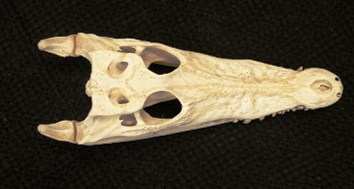
And in that soft, black towel was a hard, white skull … of a crocodylus johnstoni.  A freshwater crocodile.

A crocodile head. "Look at the eye holes."

Crocodylus, what big eyes you have on the top of your head.
All the better to see you with (when I am largely submerged in the murky water).
Crocodylus, what big nostrils you have on the top of your head.
All the better to breathe with (as I remain still, like a log in the water). 

Crocodylus, what sharp teeth you have in that long, tapering snout.
All the better to grab you with and swallow you whole, my dear!

"Look at the sharp teeth and how they fit together."

There’s a crocodile in the next room too so I borrow it to show the children. It’s a young crocodylus johnstoni prepared by a taxidermist. We look closely and see the five toes on the front feet and the four webbed toes on the back feet. We observe two lines of spikes along its back that become one line of spikes along the tapering tail. Children comment on the browns and blacks of the hard scaly body and the ‘glassy’ appearance of the  eyes. “I feel like it’s watching me all the time,” said Thea.

"Look at the four toes on the back feet."

Later we move on to Internet information and detailed big books with wonderfully clear photographs. The children draw and label their crocodile pictures. Today, we learned lots about crocodylus johnstoni… and it was fun.

Crocodiles I have seen on my walks through Argentea and Cairns Tropical Zoo…

I am cold-blooded so I warm up by basking in the sun.

I like lounging in the water, too

Lastly, a video of crocodylus johnstoni…

Have you seen crocodiles in the wild? Or in a zoo?
What more can you share about freshwater crocodiles?