Sharing Early Literacy Learning Journeys

Archive for the ‘Children talking’ Category

What did you like at the school Book Fair?

We had a Book Fair at school all this week. I love Book Fairs – they give parents an opportunity to preview and buy books for their children. On Monday my Year Ones went to the library for a ‘book look’ at the wares available. The children wrote two items on their ‘wish list’ papers and later took them home – with the understanding that there were no guarantees parents would buy the items. After school, some parents and children went to the Book Fair to browse and buy. 

Next morning several children happily showed us their purchases. Others talked about possible/probable purchases.  Both interest and excitement were high so, going with the flow, I suggested we make a graph to find out what sorts of books and things the children liked at the Book Fair.  I hasten to add that the graph was meaningful, but not beautiful!

What book or thing did you like at the Book Fair?
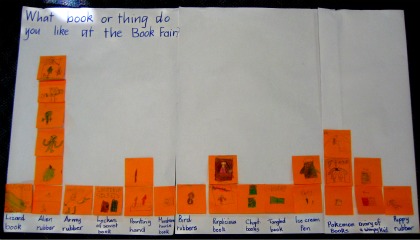
Class Book Fair graph: What book or thing do you like at the Book Fair?

What did we find out?
13 children liked ‘things’
12 children liked books

The details were interesting…

  • 9 children liked rubbers/erasers
  • 2 children liked pointing ‘hands’
  • 2 children liked ‘ice-cream’ pens
  • 5 children liked chapter books
  • 3 children liked Pokémon books (mixture of pictures, stories, information)
  • 2 children liked picture books, Purplicious
  • 1 child liked a non-fiction book , Lizards
  • 1 child liked, Lockers of Secrets (mixture of pictures, information, etc)

Surprise!
I was surprised at the results with just over half the children saying they liked ‘things’ or novelties over books – from a Book Fair.

I wondered why. Was it because:

  • ‘things’ were cheaper at $1, $2, $3, $4
  • picture books were $14, $16 or more
  • chapter books were $10 and above
  • some children were given money to buy ‘something’ – not necessarily a book
  • Book Fairs have changed by adding appealing novelty items to their wares
  • times, children and children’s interests have changed
  • other reasons?

Happy Ending
Whatever the explanation, the children’s love of books shone through at the end of the day. Yalanda couldn’t wait to show me her new  picture book, Purplicious (V. Kann, E. Kann). Capitalising on the moment, I read the book to the class and Yalanda drew about the story. I love her artwork – her characters are expressive and you almost see them move. 
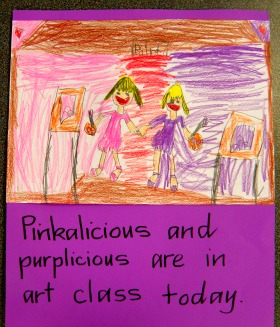
Yalana’s drawing of her new book, ‘Purplicious’.
 Please leave comments

Does your school have Book Fairs?

What do you think about the results from this graph?

Should Book Fairs just sell books?

Toys that move: push or pull?

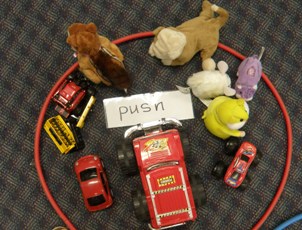
It’s toy day and the children bring toys that move. They explore push and pull forces to move their toys in different ways like rolling, spinning, bouncing and jumping. They investigate how things roll – and what makes their toys roll.

The children play with their toys to explore what the toys can do.
In a circle, the children look at and talk about the toys.

We put hula hoops on the floor with labels inside: push and pull.
Each child decides whether s/he has to push or pull to make the toy move. 

Then, a suggestion: “We need another hoop for spin because E spins her hand top.”   And a question, “Will E’s hand top spin longer than F’s beyblade?”
What do you think?

Which will spin longer – a small hand top or a Beyblade? 

Spinning top

Beyblade

Other questions come thick and fast:
           
Do you push and/or pull the levers to make a remote-control truck go? 

A child pushes and pulls the levers for the remote control truck to go

Do toy cars and trucks go better on carpet, vinyl or cement? Why?

What happens to a toy car on a steep ramp? What happens if you change the slope of the ramp?

Why does a tennis ball bounce higher on vinyl rather than carpet or grass?

For most of these toys to go, do you push or pull?

Most of the toys here today move with a 'push'


 Please leave a comment.

What force do most of your children’s toys use?

What toys do your children like to play with?  Why?


Science experiments, action and a touch of magic

Last week the children were enthralled for fifty minutes with science experiments, dramatic action and a touch of magic in an Arts Council event: H2Whoa!   Richard, the scientist, worked with water to:
• make ‘elephant toothpaste’
• fire small ‘rockets’
• display water-logged animals
• create a cyclone in a bottle
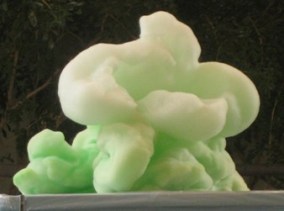
• make and throw fake snow and
• blow enormous bubbles 

Guess which ones were the children’s favourites? 

Elephant toothpaste

Water-logged animals


Enormous bubbles

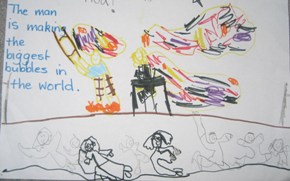
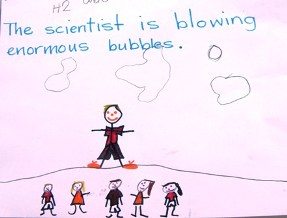
On our return to the classroom, and this time, without discussion or brainstorming, the children chose either A3 or A4 paper to draw and/or write about the show. As always, the variety of responses amazed me because I am never sure what will appeal most.

 We do not know what children like about an experience unless we give them the chance to talk  and freely respond to that experience.

The biggest bubbles in the world!

More bubbles...

… and more bubbles.

It was exciting to share a live performance and the ensuing spoken, written and visual languages were about the activity.  With pictures, sentences, words and a cup of fake snow displayed in our room, the event continues. 

Please leave your comments

Which experiment was your favourite?

What experiments can you do with water?

Who needs units of work?

My exact words on the way home last Monday were ‘Who needs units of work anyway?’ After 30 years of teaching I still get excited when special things happen with my Year Ones! If I were to share one of the most important things I have learned, it would be the value of providing children with as many opportunities as possible to make sense of their worlds.

A frog, a snake and a pink leather bag

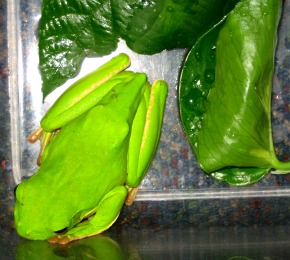
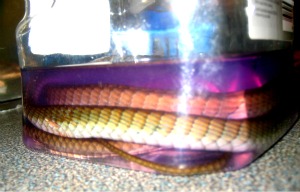
Damien arrives at the door Monday morning with a white-lipped green tree frog carefully cupped between his hands. Following behind is his Mum carrying a jar containing a dead black tree snake. Either of these items would have provided more than enough for us to work with today, but the exciting bounty of  items of interest and ‘real life’ experiences continue as others tell us about pierced ears, riding without training wheels and a pink leather bag from Florence. It wasn’t just the quantity of items and experiences that excited me, it was also the variety.

Damien brings in the white-lipped green tree frog on Monday morning.

Talk, write, read

The children clamour to see the white-lipped green tree frog in the large plastic container. Others volunteer to get a lid of water, green, shiny leaves and small branches to provide a more hospitable environment for the frog. It was a good thing they did because there was such interest that we kept him for an extra day, before releasing him happy (we hoped) and well cared for on Tuesday afternoon.

The children make the frog comfortable in his temporary home.

Meanwhile, other children examine the snake in a jar and ask, “Is it dead? Where did you find it?”

The black tree snake, preserved in methylated spirits.

Shared writing…unwrapping the bounty of real-life items and experiences

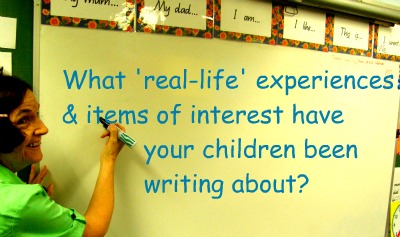
Children talk again as they compose sentences that I scribe on the whiteboard in front of them:

Damien found a white-lipped green tree frog at school this morning.
Damien also brought a black tree snake that he found on his road.
Ursula got her ears pierced for her birthday.
Margit rode her bike without training wheels.
Misty got a mask and a pink leather bag from Florence in Italy.

This is the power of shared writing. As all the children talk, write and read about the frog, snake, pierced ears, training wheels, mask and pink leather bag, the items and experiences become more ‘real’ for everyone. Writing  is the key. By slowing the talking down, by writing it down and then reading the sentences, the children simultaneously see, say and hear the words. The children have time to connect with their own worlds—they become more interested and their learning experiences intensifiy.

Children take turns at the whiteboard, pointing to each word (sense of touch) as the class reads. The sentences stay on the whiteboard until Wednesday for re-reading (repetition). Several children point out ‘ee’ in green and tree – and our word study for the day, and next day, is launched. Others announce that ‘this morning’ does not make sense on Tuesday, so the words change to ‘yesterday’. Who says children have no sense of time?

Later

I go to the library for information on frogs.

We talk about what the frog needs to live. We read from information books. One book said  frogs don’t drink water – instead, they absorb water through their soft, smooth skin. How did I get through so many years and not have that information tucked away? That’s okay – the children know that I am learning too.

I read two versions of Tiddalik, one of my favourite Australian Aboriginal Dreamtime stories… and the children draw their pictures of the giant frog.

Tiddalik - a child draws the giant frog.

Friday

After lunch I ask the children, “What did you learn about the white-lipped green tree frog?” Immediately they come up with four things they learned—and they revise the life cycle of a frog.

Frog facts the children recalled on Friday.

Units of work, or…

There is no question that children learn from planned units of work… but it’s also effective teaching to ‘go with the flow’!

Whatever the method, we owe it to our children, to give them as many opportunities as possible to write about items of interest and ’real-life’ experiences, so they can put their thoughts in order and make sense of their worlds.

Bo Bear’s Backpack – meaningful writing and reading

Children learn better when they are actively engaged in talking, drawing, reading and writing about items and experiences that are meaningful to them. Not only does this sound sensible – it’s grounded in the latest peer-reviewed research into the brain and learning. And it’s been one of my core beliefs about how children learn for many years. But how do we get children actively engaged in writing and reading about meaningful items and experiences? Let’s answer that question by unravelling the story of Bo Bear’s Backpack.

The centrepiece of the backpack:

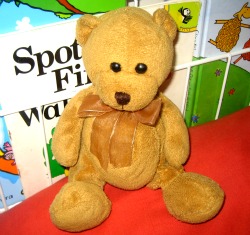
The centrepiece of Bo Bear’s Backpack is a soft toy. I have always used a toy animal because most children are interested in animals. This year it’s a bear. Other years it’s been Ziggy Zebra, Tim-Tam Tiger, Cloe Crocodile, Twin Teddies… If the idea for the animal springs from a class event or a unit of work, so much the better.

I added the AFL football to Bo Bear’s backpack to spark the interest of  boys. The AFL football and backpack were a fortunate coincidence – only a few days prior, the children had a visit from AFL player ‘Fish’! So the football and  backpack immediately connected all the children with an exciting meaningful experience.

Naming the bear:

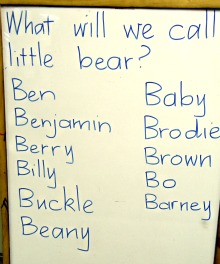
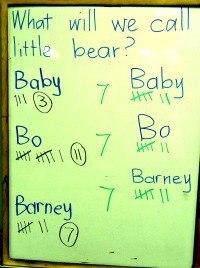
We had great fun preparing Bo Bear’s backpack on Friday. First, the little brown bear had to have a name. We gathered in our mat area and brainstormed names that started with ‘b’. The children came up with 11 possibilities which I scribed on the small whiteboard:

The children suggested 11 names for our bear.

 The vote:

In the afternoon we voted for a name. Baby, Bo and Barney won with 3 votes each – a tie. It was down to Baby, Bo or Barney. We voted again – this time by secret ballot. The children went to different parts of the room, wrote the name they wanted for the bear on a piece of paper, folded it and placed it in the box I was holding. The result – 7 votes each! Our bear was still unnamed. One child said, “We could vote again.” So we did – once again, by secret ballot (more meaningful writing and numeracy).

We tally the votes - 'Bo' is a clear winner, by 4.

 The winner:

This time Bo won – much to the chagrin of the Barney supporters! One girl commented, “Bo Bear doesn’t have the nice sound of Barney Bear.” I silently agreed, but replied that we had to go with the name that most people liked. Democracy in action! Bo Bear was named and ready to go in the backpack.

Bo Bear, named and ready to go in the AFL backpack.

What goes in Bo Bear’s backpack?
  1. Bo’s journal
  2. Writing pencils and a packet of wind-ups
  3. 6 books about bears and/or ‘b’
  4. ‘Snap’ number cards
  5. A small football  

Bo Bear, pack & contents ready to go home with the first child on Monday.

What happens when the backpack goes home?

I choose a capable child (with supportive parents) because the first entry in Bo’s journal needs to be a quality ‘model’. At home, the child…

          *plays with Bo Bear and shares the toys and books with the family
          *draws and writes about Bo Bear (or another interest) in the journal
          *reads the journal to the parents
          *reads the books with his/her parents

Some parents insert photos of their child playing with Bo Bear.

The children, draw, write and read in Bo's journal. Sometimes parents paste photos of the children in the journal.

 What happens the next morning?

The next morning, the child shares the backpack with the class and teacher. S/he talks about playing with the soft toy at home. The child reads the sentence from the journal and shows the drawing and writing to the class. We celebrate the child’s efforts. S/he may show which backpack books were read with the family. Sometimes I read one of the backpack books to the class. Comments, questions and discussion arise from other children.

Once the Journal is full, it stays in the backpack as another book to read and we make a new journal to add to the pack – more reading and writing and sharing!

Bo Bear’s Backpack ticks 10 learning boxes:

Not only do children become better readers and writers, but activities like Bo Bear’s Backpack tick 10 of the ‘keys to learning’ boxes:

          *Active engagement          
          *Interests embedded in the learning
          *Immediate and cycled repetition
          *Exercise – playing with the football
          *Talking aloud
          *Interactions with interested others
          *Purposeful learning
          *Stimulating the senses (auditory, visual, tactile)
          *Encouraging higher order thinking
         
Learn more about  Backpack Activities:

See ‘Backpacks to Go’ in Teaching Strategies for Literacy in the Early Years (Swan, 2009, p. 6-10). Extensions include:

          *An Author’s backpack
          *Email Granny’s backpack
          *Traditional tales backpack
          *Rhyming stories, songs and chants backpack         

In addition, there are backpack resource websites and parent letters.

Click on the photo below to view a list of all 41 literacy strategies:

Teaching Strategies for Literacy in the Early Years.

 View a sample strategy.  (Print and use).
Order at www.morethanreading.com


When I grow up…

It’s Friday night so I’ll keep this short. I couldn’t wait to share this drawing from today. May this ‘gem’ add  fun and inspiration to the end of your week.  Our future is in good hands!

"When I grow up, I want to be a school teacher."

This is a part of our unit, ‘Magnificent Me’. I’ll share more about what we did in a future blog. Have a great weekend! 

How was your Friday? Do you have a ‘gem’ to share?