“Hey, Honey. Get your camera. Come out here. Quick!” my husband calls.
I grab my camera and race out the sliding doors onto the back deck. In the middle of the right hand side of the back lawn sits a snapping turtle – about a foot across the shell.
A rounded, grey head protrudes from her shell – not tucked within as I have seen with other turtles – and her triangular, spiked tail sticks out the back.

Old neck folds wrinkle and gather between her head and shell.

Four grey, scaly legs protrude from the shell and get lost in the grass – ready to be cut. In fact, Bill was cutting the grass when he saw her…
We look. From front, back and sides. Grey, muddy shell. Almost smooth. Unclear markings. Round head. Not pretty. Pre-historic. Zig-zag edge at the back of her shell, from which a ‘dinosaur-like’ scaled, tail protrudes.
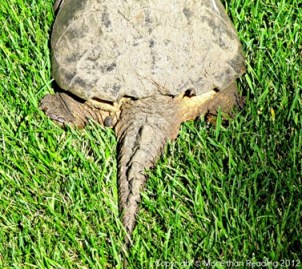
She is plopped on the ground – and looks at us. Alert. Wary. Sand is in her right eye and she rubs her right front leg across her eye as if to clear it: “All the better to see you with, my dear!”
Why is this snapping turtle on our back lawn?
Where has she been?
Where is she going?
We assume she laid eggs (in the greenbelt woodland area behind? under our back cedar trees?) and is now returning to the lake 200-300 yards in front of us… in an easterly direction.
I stop taking photos and retreat to the back deck. Give her space.
Soon, she rises slowly and walks. Lumbers really. In a straight line between our house and a neighbour’s house – no fences here. Makes it easy for her… slow and steady wins the race.

Seeing the snapping turtle heading for water reminds me of Lynley Dodds’ book (1985), The Smallest Turtle when turtle babies hatch on the beach and hear the water calling: “To the sea! To the sea!” with illustrations of hatchlings racing, stumbling and scrambling over the hot, white sand to the cool, clear sea… racing to avoid being picked off by seagulls overhead.
I run to the front of the house and peek around the corner. She’s lumbering with a steady gait, rhythmical, almost swinging. Not ungainly. Each time she sees me, she plops and stops.
I hide. She continues walking on the grass. Two neighbours come to look. She plops again. Head moving. Watching us. Each time we move out of sight, she walks – but the minute she sees one of us, she plops!
How wide is her peripheral vision?
Finally, we let her go. To get on with her task. Her walk. I hope she accomplishes her mission and reaches her destination… but first, there’s a road to cross.
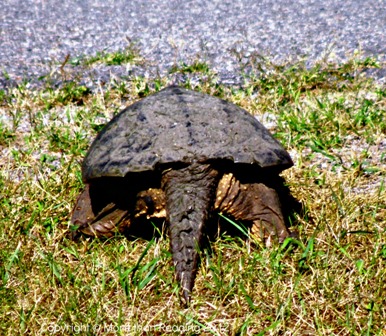
From behind a low juniper tree I watch her traverse the ditch by the side of the road and go onto the road. Steadily, rhythmically and safely she strides across the bitumen, with speed it seems – no cars come along at the time. Maybe the hard surface is easier to walk on than soft grass and ground?
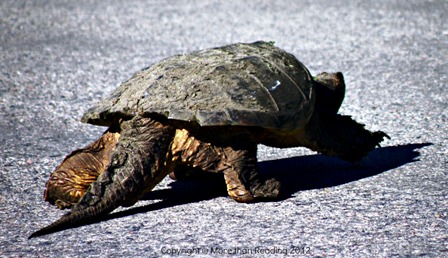
She goes up the ditch on the other side of the road, onto a neighbour’s grass. I watch her until she’s out of sight; swallowed by shadows of distant trees. Three more lawns to go, a small road, woods and then the lake…
I hope she makes it!
No wonder these signs are on highways around here.

This is the first snapping turtle I have ever seen, so I want to find out about it. ‘Just in time learning’ I call it – learning when one needs it. When information is meaningful and relevant.
How much learning in your classroom is ‘just in time learning’?
When children bring tadpoles, caterpillars, a green tree frog, a butterfly, a bird’s nest or almost anything from nature, we take the time to look, talk and share – both knowledge and experiences. Sometimes, the shared item grows into a ‘mini-unit’ or a ‘short study’ with drawings, photos, sentences, vocabulary, sounds, word work, writing and reading. And, there’s always research… books, charts and internet. ‘Strike while the iron’s hot’. ‘Just in time learning’ occurs for children and adults. We learn interesting things together.
Later, I find out that a snapping turtle’s plastron is ‘yellowish, small and cross-shaped: legs and underbelly are not well protected’ (http://torontozoo.ca).
But I had to look up the word, plastron: the under portion of the shell of a turtle or tortoise that is made up of several, often hinged, bony plates joined to the carapace by bridges located between the animal’s legs (Encarta Dictionary).
Learn more about snapping turtles: http://torontozoo.ca/AdoptAPond/turtles.asp
Tell me about a turtle you have seen.






 More than Reading Blog