Sharing Early Literacy Learning Journeys

Archive for the ‘Early literacy’ Category

Who needs units of work?

My exact words on the way home last Monday were ‘Who needs units of work anyway?’ After 30 years of teaching I still get excited when special things happen with my Year Ones! If I were to share one of the most important things I have learned, it would be the value of providing children with as many opportunities as possible to make sense of their worlds.

A frog, a snake and a pink leather bag

Damien arrives at the door Monday morning with a white-lipped green tree frog carefully cupped between his hands. Following behind is his Mum carrying a jar containing a dead black tree snake. Either of these items would have provided more than enough for us to work with today, but the exciting bounty of  items of interest and ‘real life’ experiences continue as others tell us about pierced ears, riding without training wheels and a pink leather bag from Florence. It wasn’t just the quantity of items and experiences that excited me, it was also the variety.

Damien brings in the white-lipped green tree frog on Monday morning.

Talk, write, read

The children clamour to see the white-lipped green tree frog in the large plastic container. Others volunteer to get a lid of water, green, shiny leaves and small branches to provide a more hospitable environment for the frog. It was a good thing they did because there was such interest that we kept him for an extra day, before releasing him happy (we hoped) and well cared for on Tuesday afternoon.
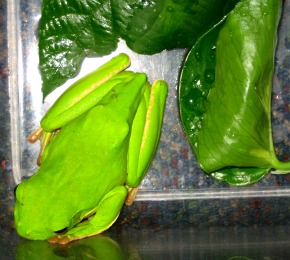
The children make the frog comfortable in his temporary home.

Meanwhile, other children examine the snake in a jar and ask, “Is it dead? Where did you find it?”
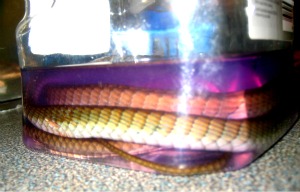
The black tree snake, preserved in methylated spirits.

Shared writing…unwrapping the bounty of real-life items and experiences

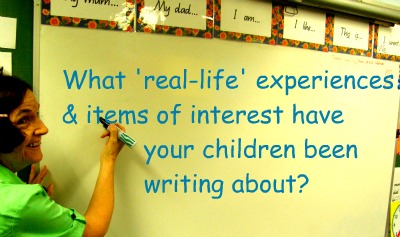
Children talk again as they compose sentences that I scribe on the whiteboard in front of them:

Damien found a white-lipped green tree frog at school this morning.
Damien also brought a black tree snake that he found on his road.
Ursula got her ears pierced for her birthday.
Margit rode her bike without training wheels.
Misty got a mask and a pink leather bag from Florence in Italy.

This is the power of shared writing. As all the children talk, write and read about the frog, snake, pierced ears, training wheels, mask and pink leather bag, the items and experiences become more ‘real’ for everyone. Writing  is the key. By slowing the talking down, by writing it down and then reading the sentences, the children simultaneously see, say and hear the words. The children have time to connect with their own worlds—they become more interested and their learning experiences intensifiy.

Children take turns at the whiteboard, pointing to each word (sense of touch) as the class reads. The sentences stay on the whiteboard until Wednesday for re-reading (repetition). Several children point out ‘ee’ in green and tree – and our word study for the day, and next day, is launched. Others announce that ‘this morning’ does not make sense on Tuesday, so the words change to ‘yesterday’. Who says children have no sense of time?

Later

I go to the library for information on frogs.

We talk about what the frog needs to live. We read from information books. One book said  frogs don’t drink water – instead, they absorb water through their soft, smooth skin. How did I get through so many years and not have that information tucked away? That’s okay – the children know that I am learning too.

I read two versions of Tiddalik, one of my favourite Australian Aboriginal Dreamtime stories… and the children draw their pictures of the giant frog.

Tiddalik - a child draws the giant frog.

Friday

After lunch I ask the children, “What did you learn about the white-lipped green tree frog?” Immediately they come up with four things they learned—and they revise the life cycle of a frog.

Frog facts the children recalled on Friday.

Units of work, or…

There is no question that children learn from planned units of work… but it’s also effective teaching to ‘go with the flow’!

Whatever the method, we owe it to our children, to give them as many opportunities as possible to write about items of interest and ’real-life’ experiences, so they can put their thoughts in order and make sense of their worlds.
Classroom reading everyday – let me count the ways…

Twice in your life you know you are approved of by everyone – when you learn to walk and when you learn to read ~ Penelope Fitzgerald

Seeing children blossom into readers is one of the thrills of my professional life. I love to see the moment when children discover that the squiggly lines on a page form letters, the letters form words and the words make sentences.

Learning to read is an extraordinary feat—it requires children to physically alter the architecture of their brains. This takes time! Steven Pinker puts it this way: “Children are wired for sound, but print is an optional accessory that must be painstakingly bolted on.”

And if you ever wondered why young children seem such natural and creative artists, it’s because babies’ brains are massively wired for picture (John Medina, 2008). Having a brain wired for picture and sound – not for word – doesn’t sound very promising does it? However this should be no surprise because until about 2000 years ago, there was no alphabet, hence no reason for us to learn how to ‘convey language through vision’  as Stanislas Dehaene so eloquently describes the act of reading.  We now expect children to accomplish this process in as little as 2000 days! (Mary Ann Wolf, 2008).

Children need all the help they can get as they grapple with connecting parts of their brains that weren’t previously talking with each other. How, as teachers, do we assist children to connect the visual, auditory and language centers of their brains?

One answer is to involve children in reading everyday in a variety of ways. Why? Because children’s brains respond to novelty, variety and repetition; children thrive on interactions with others and they pay particular attention when involved in activities that have purpose and/or meaning to them.

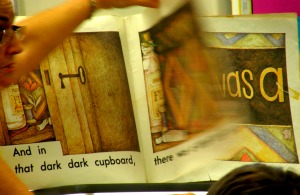
Children predict, comment & question as we read from the big book, ‘A Dark, Dark Wood’. It’s an ‘easy-to-read book’ full of lyrical language, repetition & suspense.

8 ways to engage children in meaningful reading in the classroom everyday:

  1. Reading aloud (children hearing reading)
  2. Shared and interactive reading (from big books, boards, charts and screens)
  3. Independent reading and free reading (choosing books of interest, choosing ‘good fit’ books and reading to self)
  4. Partner/buddy reading (reading to someone)
  5. Quiet reading (children choose books to read quietly on their own)
  6. Teacher monitoring (reading to me and I note what each child is ‘doing’ in reading aloud)
  7. Home reading (reading aloud to someone at home)
  8. Reading own writing (children  re-read as they write)

The more reading the better. However, regardless of how much is done, reading that isn’t enjoyable isn’t fun – and slim are the chances of nurturing children as passionate readers. One of the easiest ways to make reading enjoyable is to allow the children lots of choice in the books they read.

Each time a child discovers he can read I marvel that it’s taken him a ‘lifetime’ to begin reading words that he will soon recognise in just 500 milliseconds – less time than the blink of an eye (Mary Ann Wolf, 2008).

When I grow up…

It’s Friday night so I’ll keep this short. I couldn’t wait to share this drawing from today. May this ‘gem’ add  fun and inspiration to the end of your week.  Our future is in good hands!

"When I grow up, I want to be a school teacher."

This is a part of our unit, ‘Magnificent Me’. I’ll share more about what we did in a future blog. Have a great weekend! 

How was your Friday? Do you have a ‘gem’ to share?

Alphabet – ‘does order matter’?

Beginning teachers often ask, “Coral, how do you choose which letter to introduce? Do you follow a particular order or use a specific program like …?” I tell them, “I connect the letters with ‘real life’ and the interests of the children. For example, one year we started with ’j’ because there were 6 children in the class with names that started with ‘J’.”

Free dress day connects us with the letter ‘f’

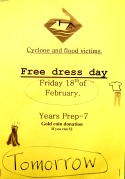
Last Friday, our school had a free-dress day and we raised money for people in floods and cyclone Yasi. The children came to school dressed in everyday clothes rather than their uniforms – and each donated a gold coin for the privilege!

Free dress poster.

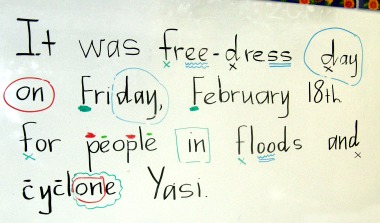
That morning our shared writing became:  It is free-dress day on Friday, February 18th for people in floods and cyclone Yasi.

Almost immediately, Pia said, “f could be our new letter.” Our shared writing about free dress day suddenly offered an opportunity to introduce and explore the letter ‘f’. It was one of those ‘teachable moments’. Brian Cambourne describes them as ‘hit-and-run-and-never-let-a-chance-go-by’ moments. I proceeded to capitalize on Pia’s observation…

The children found ‘f’ words, double letters, little words in big words and special endings.

The letter 'f' emerges from our shared writing.

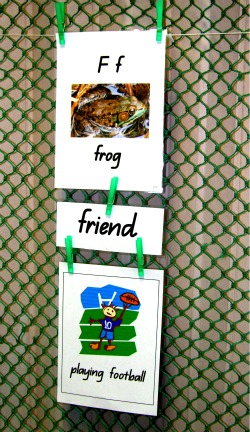
I wrote a giant ‘f’ on the board, talking about the name and the sound and we added the ‘f’ alphabet card to our word wall.

Alphabet card on our word wall.

We’ll continue our study of  ‘f’ next week:

  • Model the shape of ‘f’.
  • Talk about its name.
  • What is its sound?
  • Brainstorm ‘f’ words.
  • Draw and label five pictures of things that start with ‘f’ in alphabet books.
  • Take alphabet books for home reading. Parents help children paste/draw more ‘f’ pictures.
  • Next morning, share and celebrate the ‘f” words in the alphabet books.

Find out more…

See Alphabet Activities in Teaching Strategies for Literacy in the Early Years (pp. 1-3) including  11 extensions.

How do you introduce alphabet letters?

An amazing double coincidence!

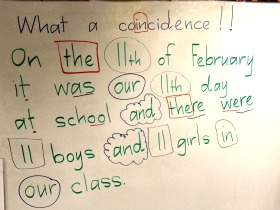
Friday, February 11th, 2011, was our 11th day at school and we had 11 boys and 11 girls in our class. The 11th day at school fell on the 11th of February because we missed three days of school due to cyclone Yasi.

It was a double coincidence because on that 11th day we also had 11 boys and 11 girls at school (with 3 absences).

Calendar time - double coincidence - Friday February 11th 2011.

In counting ‘How many days have we been at school?’ on our 100 grid, coincidences sometimes occur – but this one is pretty special.

What coincidences have you experienced?

Literacy – Magical Moments

Has it ever struck you that there are magical moments happening in your early years’ classroom?

On Tuesday, Sandy reads the morning message. “Mrs. Swan. You’ve made a mistake! One sentence doesn’t make sense – a word is missing.” Later, during shared reading of the morning message, texta in hand, Sandy inserts a carat and adds the missing word ‘the’ into our sentence. It’s a magical moment! Sandy thought for herself and solved the problem.

It’s magical when the children re-read their 5 or 6 journals at the end of the year and see their amazing progress in just 10 months.

Colin is astonished when he looks back at his first journal, “Did I write this? I can’t even read it.”  

* Can you read what Colin wrote (below) in his February journal?

* We’ll send a free copy of  Teaching Strategies for Literacy in the Early Years to the first person who sends in the correct translation of Colin’s February journal sentence by January 31st 2011.

Colin's first journal - February

Colin's fifth journal - November

Magical moments surface when children are immersed in activities that encourage discovery, interaction, cooperation, repetition – when children realize they can do something they couldn’t do before.

Misty mixes blue and yellow paint and discovers green – her joy in discovery is heard by all.

Izzy breaks new ground along her literacy journey as she writes: I have an adventurous bear…’

We see magical moments in children’s art, in their writing and reading. We hear it in their talk. We observe it in the myriad of interactions between children and between children and their environments.

We celebrate
When we see/hear ‘magical moments’ in the classroom, we share them – we celebrate the magic. We share how children are thinking for themselves. We share how children are doing things for themselves. We share how the ordinary changes to extraordinary.

What is a favourite magical moment from your classroom?

Coming next: Starting the School Year

Early Literacy – Welcome

The purpose of this blog is to share ideas and strategies for effective literacy teaching and learning in the early years. It’s a privilege for us to work with young children – to experience their originality, creativity and excitement in learning. Let’s share magical moments from our classrooms. Come along for the ride – add your comments and we’ll learn from each other. 

Coming next: Early Literacy – Magical Moments

Coming soon: Starting School series including… 
*organising my room 
*establishing activity areas
*all the little bits
*the first day…