Sharing Early Literacy Learning Journeys

Archive for August, 2011

Book Week with a Book Parade

Last week in Australia, we celebrated Book Week. We read short-listed books and winning books from the Younger Readers and Early Childhood Books Categories. I know how we early years teachers (and parents) are always looking for good books for our children, so in this blog you’ll find photos and my descriptions of 3 books that my Year Ones particularly enjoyed. And for those of you who enjoy quizzes, there’s a skill testing question for you in the caption under a child’s drawing in the Book Parade section. Enjoy!
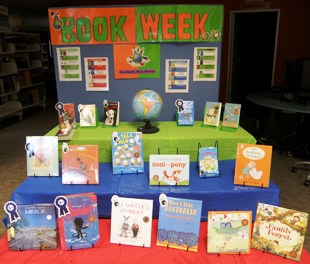
Book Week Books displayed in the Library

My class especially loved Look see, look at me, The Tall Man and Twelve Babies and Noni the pony.

Perfect for toddlers – and early readers!
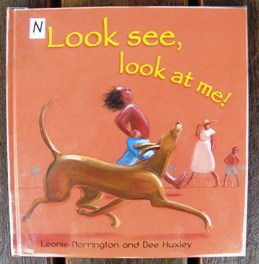
Look see, look at me! is perfect as a read aloud for toddlers  – and ideal for early readers. I like to have any number of  ‘easy to read’ books in my Yr 1 classroom at the start of the year because they provide reading materials for beginning readers – without being ‘levelled books’.

'The Tall Man and the Twelve Babies'

The Tall Man and the Twelve Babies was appealing and funny. The children loved how the babies were all called Aliastair or Charlene. They laughed at the thought of the all the babies laughing together – and all crying together! They loved how the babies had mashed bananas for breakfast and mashed potatoes for tea. One girl commented that the cat was eating the mashed potato – so where was the 12th baby?
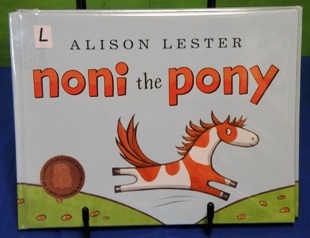
'noni the pony': an appealing book in rhyme

Noni the pony is rollicking and rhythmical with a simple storyline that was fun for the group. One boy liked the way the dog was similar in colour to the pony and blended in when Noni protected the dog and the cat. Others laughed at the cows watching Noni dance. “What is spooked?’ asked another – so a discussion of ‘scary’ words ensued.

On Wednesday morning we had our P-3 Book Parade:

Children dressed up as their favourite book characters. I was Little Red Riding Hood.

The witch from ‘Room on the Broom’ appeared

Who are the book characters in this girl's drawing? Place your answers in 'comments'.

A Book Worm cake was part of the celebrations too.

A 'Book Worm' cake was part of the celebrations too!

How did you celebrate Book Week?

Building bushland and crocodile habitats in a Year 1 classroom

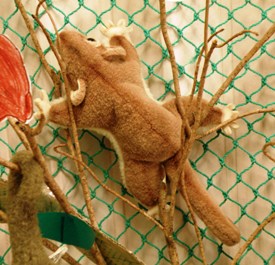
A branch stands in a bucket and sticks, leaves and gumnuts litter the floor in the ‘bushland’ area of the classroom. A koala, kookaburra, ring-tailed possum and sugar glider sit and hang in the branches. Kangaroos are on the ‘ground’ along with assorted snakes, ants and insects. By the windows, a green tree frog sits on the rafters looking down at the hanging vines, sand, ‘mangroves’ and crocodiles who live in the ‘crocodile habitat’ below. The geographical areas and animals reflect our unit of work this term: Australian Animals.

A possum hangs from a branch

A glider hangs hangs on for dear life

Kangaroos look for grass amongst the leaves

The green tree frog looks for a damp area

Crocodile habitat – with turtles and frogs in the mix.

The children choose one animal to study. They write a ‘What am I?’ for a class big book – and they learn interesting facts about that  animal. For example, did you know that:

  • really hungry crocodiles will eat bats?
  • most kangaroos can only move both back legs together and not one at a time?
  • green ants can carry up to 20 times their weight?
  • wombats have backward-facing pouches so dirt does not get over the young as wombats dig?
  • koalas sleep about 75% of their time?
This koala is awake!
How are your units of work refelcted in your classroom?

Crocodylus johnstoni

Chloe’s mum came into school today carrying a dark, dark box.
And in that dark, dark box was a soft, white towel.
And in that soft, white towel was a soft, black towel.
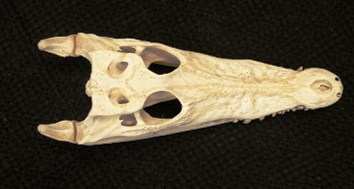
And in that soft, black towel was a hard, white skull … of a crocodylus johnstoni.  A freshwater crocodile.

A crocodile head. "Look at the eye holes."

Crocodylus, what big eyes you have on the top of your head.
All the better to see you with (when I am largely submerged in the murky water).
Crocodylus, what big nostrils you have on the top of your head.
All the better to breathe with (as I remain still, like a log in the water). 

Crocodylus, what sharp teeth you have in that long, tapering snout.
All the better to grab you with and swallow you whole, my dear!

"Look at the sharp teeth and how they fit together."

There’s a crocodile in the next room too so I borrow it to show the children. It’s a young crocodylus johnstoni prepared by a taxidermist. We look closely and see the five toes on the front feet and the four webbed toes on the back feet. We observe two lines of spikes along its back that become one line of spikes along the tapering tail. Children comment on the browns and blacks of the hard scaly body and the ‘glassy’ appearance of the  eyes. “I feel like it’s watching me all the time,” said Thea.

"Look at the four toes on the back feet."

Later we move on to Internet information and detailed big books with wonderfully clear photographs. The children draw and label their crocodile pictures. Today, we learned lots about crocodylus johnstoni… and it was fun.

Crocodiles I have seen on my walks through Argentea and Cairns Tropical Zoo…

I am cold-blooded so I warm up by basking in the sun.

I like lounging in the water, too

Lastly, a video of crocodylus johnstoni…

Have you seen crocodiles in the wild? Or in a zoo?
What more can you share about freshwater crocodiles?

10 for 10: My ‘must have’ picture books

What are the  ‘must have’ picture books in your classroom and library?  10 favourite picture books shared on blogs via Twitter on August 10 was instigated by @mandyrobek and @CathyMere – check #PB10for10.  Here is my list of ten special picture books  that I must have in my Year One classroom and library.

1. Where is the Green Sheep? by Mem Fox is a beginning year favourite. Lyrical and rhythmical language swings right along and whimsical, colourful illustrations add to its appeal. It’s a great book that helps ‘learning to read’ children.

2. Chicka Chicka Boom Boom by John Archimbault is a rollicking good read with alphabet letters never being so much fun.  Colourful illustrations add to the light and bright feel of the book as children easily sing along  – again and again.

3. No David  by David Shannon is a special favourite with my classes because it’s funny. Young children identify with David’s antics and his mother’s reactions. Every year I have at least one child learn to read from this book.

4. Just for You by Mercer Mayer is a gem. Contrasts between the character’s intentions and the end results are funny and ‘sketchy’ illustrations add to the hilarity.  Children love looking for the spider and the cricket, too. 

5. Titch by Pat Hutchins is a delightful story of a youngest child who never quite catches up to his sister and brother – until the end.  The direct language, simple storyline and clear illustrations make it another good choice for ‘starting the year’.

6. The Potato People by Pamela Allen is a moving story for some children with Jack and his mum leaving for a time, putting an end to Jack and Grandma’s fun-filled Fridays. The potato people know sorrow too… Seize the moment and have children make their own potato people.

7. Grug  by Ted Prior is a delightful character who grows from a tree and makes a home in a deserted burrow on a grassy hillside. Children laugh out loud at his wayward adventures that are often accompanied by hilarious illustrations.

8. Giraffes Can’t Dance by Giles Andreae, is a wonderful story that provokes and inspires. The lyrical, rythmical language and colourful, expressive illustrations add to its charm.

9. Horton Hatches the Egg by Dr Suess is still a favourite with the rhythmical language and endless appeal of Suess illustrations. Despite the length for young children, we always go home happy, 100%.

10. Go, Dog, Go by P. D. Eastman is a classic that still has children laughing and talking about the dogs in fast cars and the hilarious dog party.

Listing ten favourite books is easy… stopping at ten is the hard part!

Several of my favourite authors are listed here and I like many of their books.  Mem Fox is a favourite and choosing between Where is the Green Sheep? Koala Lou, Hello Baby, Boo to a Goose and Possum Magic is difficult. Pamela Allen, Pat Hutchins, Mercer Mayer, Dr Suess… how does a person choose ‘just one’ of their books?

Maybe we need a list of favourite authors with lists of all their books you love!

What are your 10 favourite picture books for young children?

Used books from the school fete

It’s dull and cloudy as I drive to school on Saturday morning to help prepare for the fete.  I arrive at the Book Stall and find the convener already arranging boxes of books on long trestle tables in the under cover area – just as well it’s under cover because light rain begins to fall. Several people haul  in more boxes of books and dump them on the tables. We read the labels on the boxes and place them in order: Prep – 4, 2 for 50c; Prep – 4, fiction; Prep – 4, non-fiction, and so on. Quickly I flip through to see that the appropriate coloured dot stickers are on all the books: blue dot (2 for 50c), black dot (50c), yellow ($1.00).

After the children’s tables are done we move to more boxes of books on more trestle tables:  adult authors in alphabetical order, interest categories in alphabetical order: Animals, Biography, Business, Cooking, Crafts, Gardening, Games and so on down to Self-help and Sports (where last year I got Andre Agassi’s Open for $2).

Later, I go through the children’s boxes more slowly to find books I could use in my classroom. I find familiar books like The Gruffalo, Room on the Broom, I’ll Teach My Dog 100 Words, Put Me in the Zoo, Crunch the Crocodile, Alfie Gets in First, several versions of The Little Red Hen and a quality hardcover of  A. A. Milne’s When We Were Very Young and Now We Are Six.

I also find some unfamiliar, but appealing books like a starkly simple book of Opposites, an easy to read Cat and Dog, a read it yourself Quick Chick, Kate Greenaway’s Book of Rhymes, a colourful picture book, Splodges and a timely Tale of Two Honey Possums (for a child who is studying honey possums in our Australian Animals unit of work this term).

One pile of books from the school fete

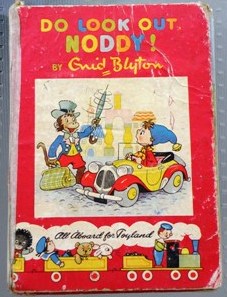
An old 'Noddy' book, dated 1957

An old school ‘reader’, first published in 1939. This revised Third Impression is from 1975

Here are two excerpts from the ‘reader’ with Dick and Dora as the main characters and Jack and May as their friends:

Play
“Jack, will you play with me , please?” said Dick.
“Yes,” said Jack. “What can you do?”
“Bow-wow-wow!” said Dick. “What am I?”
Jack said, “You are a dog. A dog can go ‘bow-wow-wow’.”
Dick said, “What can you throw?”
“I can throw a ball,” said Jack.
(Schonell and Serjeant, p. 2).

In the Park
Dick, Dora, Jack and May went to the park.
By the big tree in the park they will have fun.
Dora has her doll, Jane. May will play with Dora and her doll.
Jack and Dick can play with the dog.
They can throw the ball and Nip will get it. He is a good dog.
(Schonell and Serjeant, p. 24-25).

What childhood memories do these books ellicit for you?