Sharing Early Literacy Learning Journeys

Archive for January, 2012

What words work for you? Thank you… and a quick reflection

In my last blog ‘What words work for you?  Shaping children’s behaviours in your early years classroom’ I mentioned that one of my favourite ‘words that work’ is ‘Thanks’… as in… “Close the door. Thanks.” Upon reflection, I thought it may be helpful to explain that I use ‘Thanks’ in this context because I am expecting that the door WILL be closed — it is not a choice, it is not a ‘please’, it is not a ‘can you?’.

I also use ‘Thanks’ to show appreciation and gratitude… as in… ‘Thanks for bringing the green tree frog, Alistair,’ or ‘Thanks for the great idea, Hilary’.

‘Thanks is always positive.

Lastly, ‘Thanks’ to those early years teachers who have kindly taken the time to share their ‘Top 3 Words that work.’

Do you have 3 favourite ‘words that work’ to add to the list before it is compiled and published on Thursday?

What words work for you? Shaping behaviours in your early years classroom…

Shirley and I are supervising 50 children from our two classes on the verandah as they eat lunch and put lunchboxes away. Some children are sitting, waiting for the bell. Jaydeen is pushing her friend and shouting. It’s a situation early years teachers often encounter. How should we react? What words work at times like this? Do some words work better than others?

The answer plays out in front of me…

“Jaydeen. OTT,” says Shirley quietly. Jaydeen looks sheepishly at her teacher, then sits down with classmates ready to go out for play.

“Wow. That works well, Shirley. What’s OTT?” I ask.
Shirley smiles and replies, “Over The Top.”
I turn to her and nod, “I could try that…”

Shirley’s acronym, OTT  and words ‘Over The Top’ are new to me. They are simple and they work. I like her words and I like her calm, positive tone as she uses ‘words that work’ for her, to shape Jaydeen’s behaviour.

I call them ‘words that work’ —words that get the desired result, quickly, effectively and with minimal fuss and muss.

What are the top 3 ‘words that work’ for me in shaping children’s behaviour?

Top 3  ‘Words that work’  for me:

Thanks                         …as in, ‘Close the door. Thanks.’

Quality                          …as in,That’s quality work.’

Either/Or                    ‘Either keep your hands to yourself, or leave the group.’

Whether you are grappling with inappropriate behaviours, or nurturing good behaviours into even better ones, I wonder ‘what words work’ particularly well for you?

In the comments box, tell us about the top 3 ‘words that work’ for you.
I know we also use gestures, sounds etc. to shape behaviours, but for now let’s stick to words that work for you. It could be an acronym like Shirley’s, a phrase or two words. It doesn’t matter. Let’s share and learn together.

I’ll compile the list of ‘words that work’ and publish them so you can pick and choose ones that work for you.

Tweet this post, like it on Facebook, e-mail it to your friends, so we can share as many ‘words that work’ as possible by the end of January.

I hope your first week back is going well.

Thinking about school – over coffee

Can we meet at 9:30? At the southern end? See you then!

Three friends happily greet each other, find comfortable seats and order coffees and teas. School starts next week. We exchange books: Interactive Writing, Literacy Work Stations, Narrative Inquiry – but today, we don’t take the time to peruse and discuss them. Instead, conversation flows around the new school year. “Have you been into your room yet?”  “How many children in your class this year?”  “Will you do anything differently?”

We discuss concerns about typically ‘touchy’ topics—levelled books, sight words, home reading…. and today, the new Australian curriculum. We share classroom ideas—about building word walls, using new picture books, adapting aspects of the Daily5.

Finally, we encourage personal growth interests—blogging, Pinterest, photography – pursuits that are important to our professional and personal lives, despite family commitments, work constraints and never enough time. We’ll continue to text, email and meet over coffee.

In the meantime…

Here are two resources to help you get started with school:

1: A re-publish of my Starting School Series of blogs which will be e-mailed to my blog subscribers daily this week, including:

4 Days to go – organising activity areas: mat area, computer area, word wall…
3 Days to go – unpacking, sorting and starting the calendar wall…
2 Days to go – selecting reading, maths, science & art materials…
1 Day to go – message board, name tags, book baskets, hands-on materials…
First day – getting children reading, writing and drawing on day one…

and

2: Three downloads of rhymes – ideal for beginning readers in the first weeks of school. Click on a title and save or print your copy:

10 Rhymes to start the year
Ten lyrical rhymes to use with your beginning readers.

8 Number Rhymes
Eight great counting and number rhymes for beginning readers.

8 Transition Rhymes
Eight ryhmes for early years teachers to transition children smoothly from one activity to another.

ENJOY!

Coral

Python Dines on Christmas Wallaby

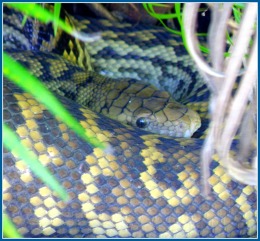
New Year’s Eve. Early morning. A brisk walk.  Around the resort. Stop occasionally. Take photos. Mainly flowers. Bright red. Pink. Yellow. Pass walkers. Chat to workers. A couple asks, “Do you want to see a python? A big python? A 4 metre python that ate a small wallaby on Christmas Day?”

Walk. Past a small, Chinese shrine. Up a short, steep hill. Almost stumble on stones. Turn right. Cross mown, green grass. See golden cane palm. Eyes search tangle of dead fronds.  Adjust from sun to shade. Careful. Not too close! Through the camera lens from here. A curled up python. A patterned python. Camouflaged. One part of his body MUCH wider than the rest. The wallaby?
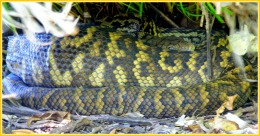
The curled up python was resting and digesting

The couple watched the python swallow the small wallaby on Christmas Day, “…being careful not to disturb the snake as he ate because surprise or stress can cause the prey’s bones to break and maybe rupture the snake’s skin or stomach,” added another local.

Six days later. Snake still resting and digesting.
Body still very wide in one part.

Left wondering. How did the python catch the wallaby?  Did it silently slither over the grass, drop down from an over-hanging branch or coil and spring at the wallaby?
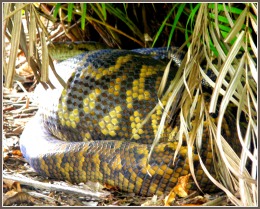
That's one stretched tummy!

The python looked docile, but he kept a watchful eye on us...

I couldn’t wait to share this morning’s rich experience with you, partly because it’s a fascinating glimpse into nature, but more importantly, it took me back to when our children were 5 or 6 years old and how, whilst walking—on a beach, in a rainforest, along a country road–we forged lasting family memories and made some of our most interesting and unexpected discoveries: a Leatherback turtle laying eggs in the sand; a brilliant blue Ulysses butterfly; a sleek red-fox searching for his supper. But most significantly, we spent time together—laughing, sharing, discovering, talking.

We don’t have to live near a beach or rainforest—it can be a sidewalk, a park, a backyard. It doesn’t matter where we are; we can always learn from our children—they are naturally and insatiably curious, and often notice things adults miss. When we respond to our children’s comments and questions, something special happens—we learn together.

I love the following story. John Medina paints a beautiful picture of the magic that can happen when a parent walks with a child:

 “My two year old son Noah and I were walking down the street on our way to preschool when he suddenly noticed a shiny pebble embedded in the concrete. Stopping midstride, the little guy considered it for a second, found it thoroughly delightful, and let out a laugh. He spied a small plant and an inch farther, a weed valiantly struggling through a crack in the asphalt. He touched it gently, then laughed again. Noah noticed beyond it a platoon of ants marching in single file, which he bent to examine closely. They were carrying a dead bug, and Noah clapped his hands in wonder. There were dust particles, a rusted screw, a shiny spot of oil. Fifteen minutes had passed, and we had gone only 20 feet. I tried to get him to move along, having the audacity to act like an adult with a schedule. He was having none of it. And I stopped, watching my little teacher, wondering how long it had been since I had taken 15 minutes to walk 20 feet”.

(John Medina, 2008, Brain Rules, p. 278-279, Seattle, WA: Pear Press).

In a Nutshell:
Going for a walk is one of the easiest ways to spend precious time with your child. And, above all, when you spend time with your children, you send them the most important message of all—that you love them.

Comments:
I’d love to hear your story about a walk you took with your child—something beautiful, something scary, something you learned, something you’ll never forget…

Lets’ inspire parents to walk with a child.