Sharing Early Literacy Learning Journeys

Archive for May, 2011

Lively learning on Japan Day

Konnichiwa.
Japanese is the Language Other Than English (LOTE) taught in our school. To raise money for the Japan earthquake and tsunami victims, our LOTE teachers and Japanese parents organised ‘Japan Day’. The student body then participated in various cultural activities on offer. The activities included:

      • Mizu yoyo (water balloon yoyo with an elastic ‘string’)
      • Origami (paper folding)
      • Kimono dress up time
      • Jan Ken Pon (paper, scissors, rock)
      • Kendama (wooden toys)
      • Hachimaki (headbands)
      • Zumba

        Mizu yoyos waiting to be chosen by excited children

        Dressing up in kimonos was a favourite activity
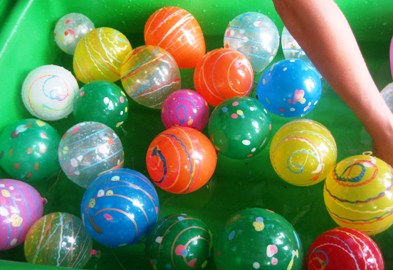
Headbands were a favourite too. This one says ‘Pokemon’

Jan Ken Pon (paper, scissors, rock) was also a favourite – partly because if a child beat the mum opponent, the prize was a lolly!

Sushi and rice balls
 Sushi and rice balls are already on the Tuck Shop lunch menu – but LOTS were eaten on Japan Day.
 
A class book
Next day, we brainstormed words about the experience and listed them on the whiteboard. Then, the children wrote about their day. In conversations about the writing, we talked of adding information, details and feelings.  The children drew colourful pictures on their printed pages of writing and added the pages to an A4 display book. Voila!  A class book for shared, independent and home reading.
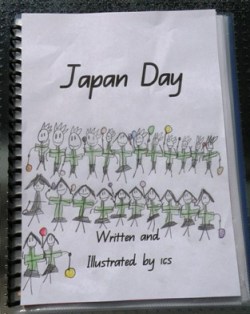
Class book of children's writing and pictures about Japan Day

Class charts
Digital photos were used for class charts and displays with pictures, captions, labels and ‘stories’.

A visual PowerPoint
Photos and captions of the activities are on a lively and colourful Powerpoint presentation for classroom use.

Classic Language Experience
Japan Day was a classic Language Experience activity where we:

  • shared a hands-on class experience
  • shared spoken, written and visual language about the experience
  • brainstormed, wrote and used words about the experience
  • constructed class sentences about the experience
  • wrote and drew about the experience
  • made a class book from the children’s writing – for shared, individual and home reading
  • used photos, captions and sentences for reading charts and displays of the experience
  • used the children’s writing as high interest reading materials
  • re-lived the experience by interacting and re-reading the children’s work/products 

Sayounara…and please leave a comment

What did you like about Japan Day?

What new Japanese words did you learn?
What did you like at the school Book Fair?

We had a Book Fair at school all this week. I love Book Fairs – they give parents an opportunity to preview and buy books for their children. On Monday my Year Ones went to the library for a ‘book look’ at the wares available. The children wrote two items on their ‘wish list’ papers and later took them home – with the understanding that there were no guarantees parents would buy the items. After school, some parents and children went to the Book Fair to browse and buy. 

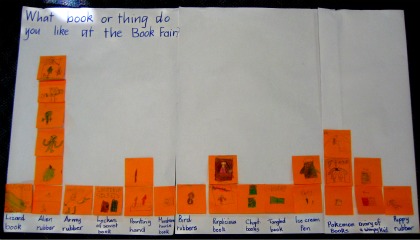
Next morning several children happily showed us their purchases. Others talked about possible/probable purchases.  Both interest and excitement were high so, going with the flow, I suggested we make a graph to find out what sorts of books and things the children liked at the Book Fair.  I hasten to add that the graph was meaningful, but not beautiful!

What book or thing did you like at the Book Fair?

Class Book Fair graph: What book or thing do you like at the Book Fair?

What did we find out?
13 children liked ‘things’
12 children liked books

The details were interesting…

  • 9 children liked rubbers/erasers
  • 2 children liked pointing ‘hands’
  • 2 children liked ‘ice-cream’ pens
  • 5 children liked chapter books
  • 3 children liked Pokémon books (mixture of pictures, stories, information)
  • 2 children liked picture books, Purplicious
  • 1 child liked a non-fiction book , Lizards
  • 1 child liked, Lockers of Secrets (mixture of pictures, information, etc)

Surprise!
I was surprised at the results with just over half the children saying they liked ‘things’ or novelties over books – from a Book Fair.

I wondered why. Was it because:

  • ‘things’ were cheaper at $1, $2, $3, $4
  • picture books were $14, $16 or more
  • chapter books were $10 and above
  • some children were given money to buy ‘something’ – not necessarily a book
  • Book Fairs have changed by adding appealing novelty items to their wares
  • times, children and children’s interests have changed
  • other reasons?

Happy Ending
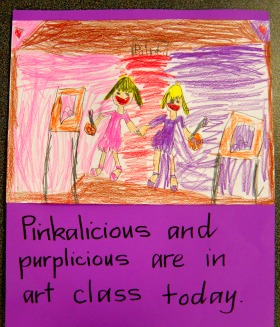
Whatever the explanation, the children’s love of books shone through at the end of the day. Yalanda couldn’t wait to show me her new  picture book, Purplicious (V. Kann, E. Kann). Capitalising on the moment, I read the book to the class and Yalanda drew about the story. I love her artwork – her characters are expressive and you almost see them move. 

Yalana’s drawing of her new book, ‘Purplicious’.

 Please leave comments

Does your school have Book Fairs?

What do you think about the results from this graph?

Should Book Fairs just sell books?

Toys that move: push or pull?

It’s toy day and the children bring toys that move. They explore push and pull forces to move their toys in different ways like rolling, spinning, bouncing and jumping. They investigate how things roll – and what makes their toys roll.

The children play with their toys to explore what the toys can do.
In a circle, the children look at and talk about the toys.

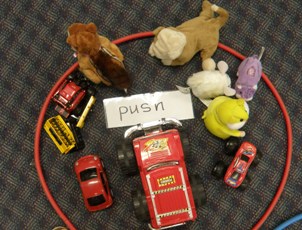
We put hula hoops on the floor with labels inside: push and pull.
Each child decides whether s/he has to push or pull to make the toy move. 

Then, a suggestion: “We need another hoop for spin because E spins her hand top.”   And a question, “Will E’s hand top spin longer than F’s beyblade?”
What do you think?

Which will spin longer – a small hand top or a Beyblade? 

Spinning top

Beyblade

Other questions come thick and fast:
           
Do you push and/or pull the levers to make a remote-control truck go? 

A child pushes and pulls the levers for the remote control truck to go

Do toy cars and trucks go better on carpet, vinyl or cement? Why?

What happens to a toy car on a steep ramp? What happens if you change the slope of the ramp?

Why does a tennis ball bounce higher on vinyl rather than carpet or grass?

For most of these toys to go, do you push or pull?

Most of the toys here today move with a 'push'


 Please leave a comment.

What force do most of your children’s toys use?

What toys do your children like to play with?  Why?


Science experiments, action and a touch of magic

Last week the children were enthralled for fifty minutes with science experiments, dramatic action and a touch of magic in an Arts Council event: H2Whoa!   Richard, the scientist, worked with water to:
• make ‘elephant toothpaste’
• fire small ‘rockets’
• display water-logged animals
• create a cyclone in a bottle
• make and throw fake snow and
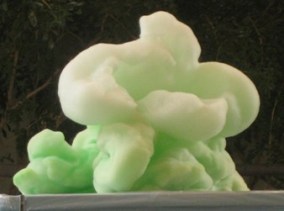
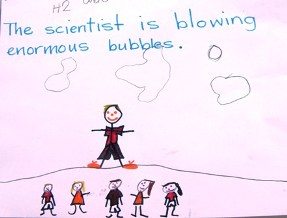
• blow enormous bubbles 

Guess which ones were the children’s favourites? 

Elephant toothpaste

Water-logged animals


Enormous bubbles

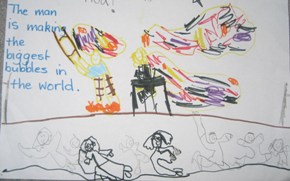
On our return to the classroom, and this time, without discussion or brainstorming, the children chose either A3 or A4 paper to draw and/or write about the show. As always, the variety of responses amazed me because I am never sure what will appeal most.

 We do not know what children like about an experience unless we give them the chance to talk  and freely respond to that experience.

The biggest bubbles in the world!

More bubbles...

… and more bubbles.

It was exciting to share a live performance and the ensuing spoken, written and visual languages were about the activity.  With pictures, sentences, words and a cup of fake snow displayed in our room, the event continues. 

Please leave your comments

Which experiment was your favourite?

What experiments can you do with water?